



Writer Write-Up: Natasha Sharma

Natasha Sharma is one of India’s most well-known children’s authors, with over a dozen books to her name. Her popular books, Icky, Yucky, Mucky and Kaka and Munni, have been performed at various literary events across the country. Her iconic History Mystery series has a huge reader base and is one of the most popular series in kids’ literature.

Natasha’s tryst with writing began long before her first book Icky, Yucky, Mucky. However, it was this book that made her realize how much she enjoyed the process of writing stories for kids. Interestingly, the book was initially written in verses but was elaborated to prose when the editor of Young Zubaan, Anita Roy, told her to do so. The book hilariously touches upon some of the bad habits that kids and adults easily fall into, including not-so-pleasant table manners.

However, she does feel strongly that children’s literature in India is not given its due and that’s primarily because of the issues of discoverability.

“Indian kid-lit is often relegated to one corner of a book store with a fused bulb and cartons of stock lying in front of it. That’s the ground reality. We lack good, well-established, well-known review spaces. To be able to get the word out, you need people in the mainstream, large media houses, bloggers… you need an entire village to build this. It’s not just about us selling a book, it’s about getting a child enthused about reading which is the ultimate goal for everyone.”

Her first book from the History Mystery series,  Akbar and The Tricky Traitor, grew out of a writing workshop that Duckbill Books conducted in Mumbai. One of the exercises in the workshop was to pick a genre in which participants would have never considered writing a book. To add to the challenge, participants also had to pick a random object from a black bag and make it an essential part of the story. Natasha picked historical fiction… and a sock!

So how does Natasha balance historical settings with contemporary voices and make it sound exciting for kids?

“I do a ton of research and I don’t write anything until it’s over. The research could go on for as long as six months. I prepare notes and try to dig out some information that kids would never get to learn in their history textbooks. The fun bits of history are always left out for some reason. When I begin writing, I make sure I don’t force fit information into the story because it takes the joy away from storytelling and for the reader as well. Then I come up with interesting names for each of my character. “

Listen to hear more from Natasha and hear her read an excerpt from her book ‘Akbar and The Tricky Traitor’ in the video above.

#ACKandFriends is an online talk show by our Amar Chitra Katha editorial team, where we connect with India’s top children’s authors and give audiences a sneak peek into the creative process behind writing books for kids. Watch Season 1: Click here 

Stay tuned for Season 2 coming soon.
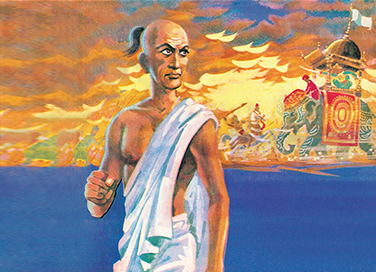
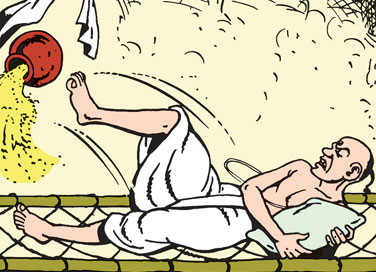
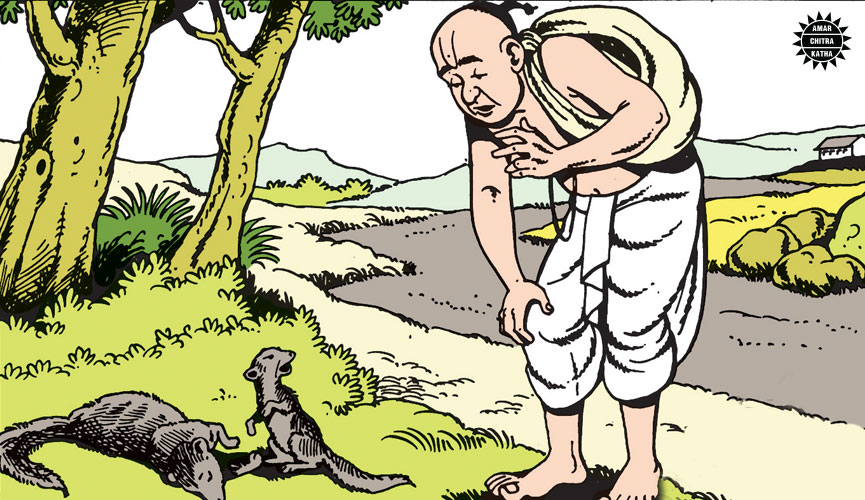
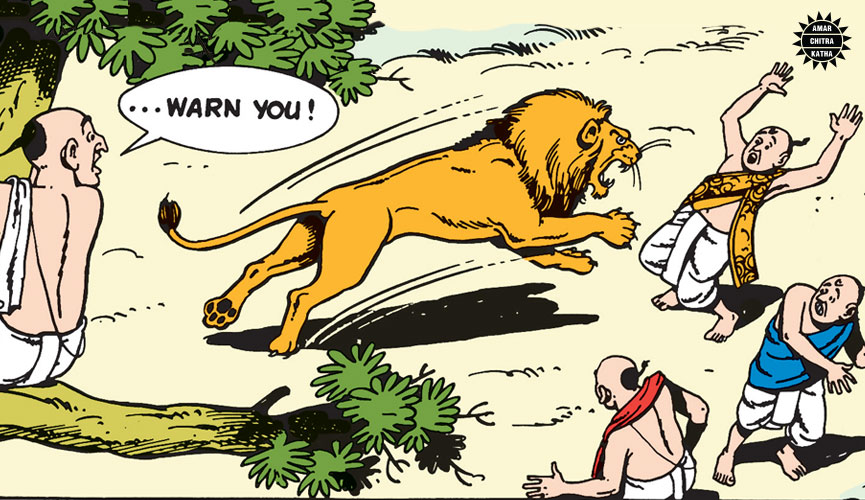
Five Life Lessons By Chanakya

Illustration: Ram Waeerkar

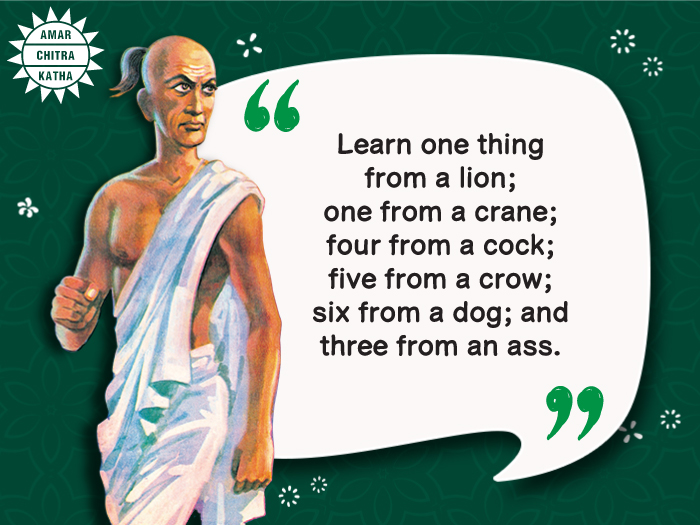
Acharya Chanakya, also known as Kautilya or Vishnu Gupta, was an Indian scholar, political advisor, economist, philosopher and teacher. Under his mentorship, Chandragupta Maurya, a commoner by birth, became the emperor of the Mauryan Empire. His popular works are Arthashastra and Neeti Shastra. These principles written by him between 370 BCE to 283 BCE hold true even today. While every era has witnessed some kind of transformation, Chanakya’s teachings have stood the test of time. Even today, his principles are taught to management students and business professionals as Chanakya Neeti. Here are a select few neetis that contain important life lessons, as told by the master himself. 

Illustration: Ram Waeerkar

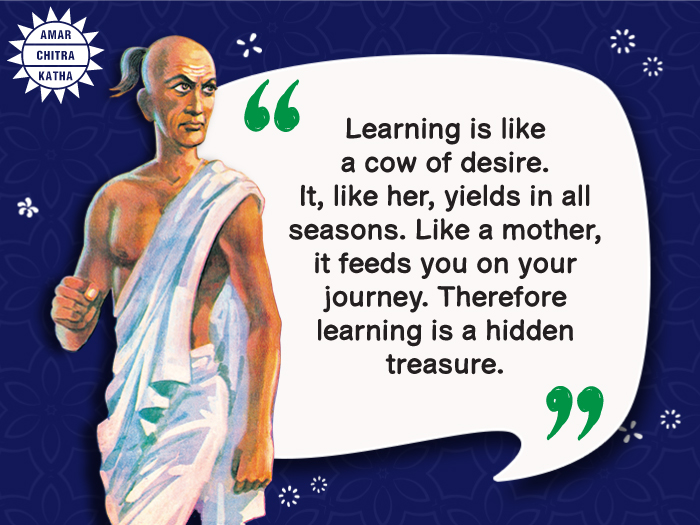
Chanakya emphasises the importance of learning. Materialistic gains may be lost but the knowledge acquired through learning is never wasted. It is truly the gift that keeps on giving. It is never too early to start learning nor is it ever too late. So start now! 

Illustration: Ram Waeerkar

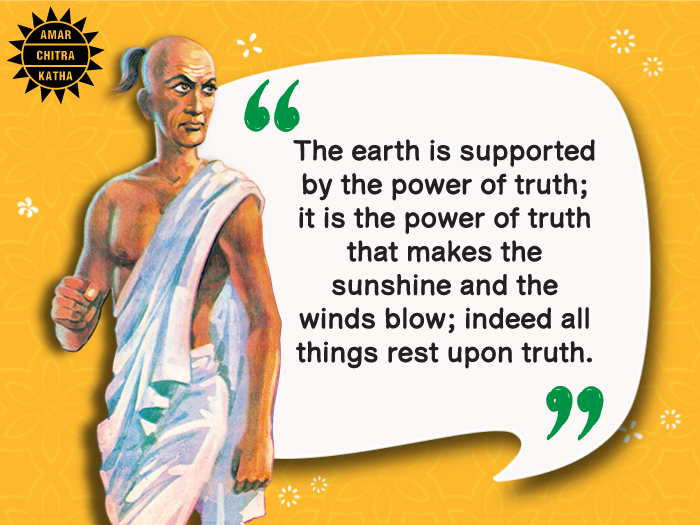
Truth triumphs all. It stands bare, free, and fearless. It is easy to create a mountain of lies, but it is impossible to bear its weight for long. On the crossroads of life, choose the right path and always speak the truth. Truth gives you the power to withstand every challenge.

Illustration: Ram Waeerkar

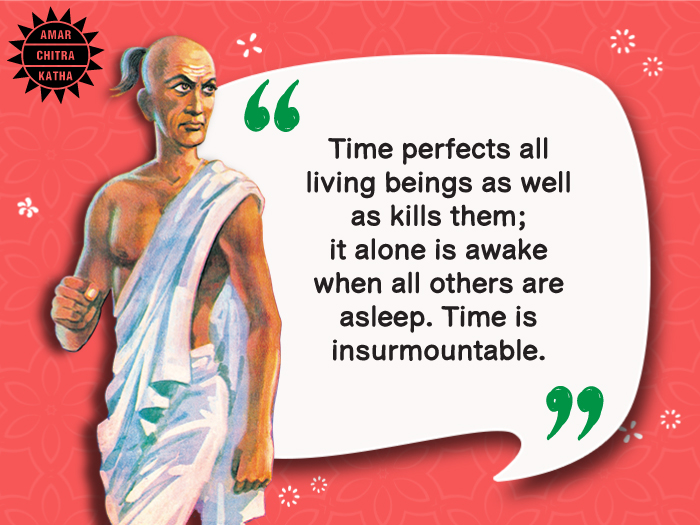
Here, Chanakya beautifully emphasizes the importance of time. You cannot race against time, neither will time wait for anyone. Thus, it is essential to make the most of what you have and what you can do when you have the luxury of time. Everything falls in place with time. Never judge or criticise yourself comparing your pace with someone else’s. Each of us operate on different clocks after all. You will reap what you sow only when the time is right for you.

Illustration: Ram Waeerkar

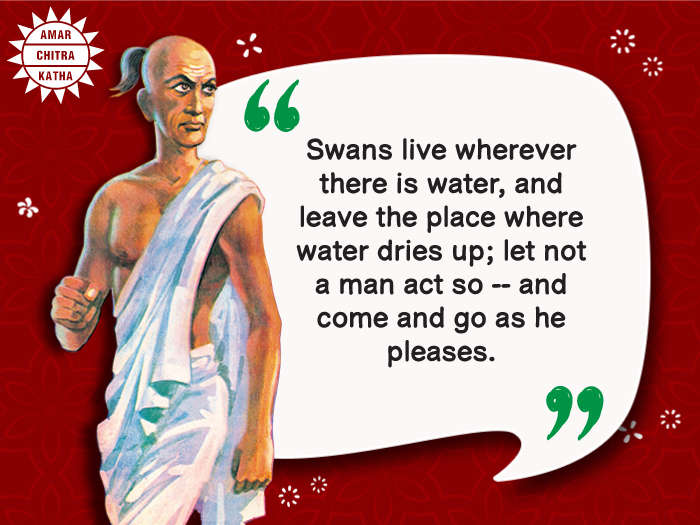
It is easy to judge yourself through the eyes of others. This holds true even more so today in the digital world we live in. People determine their self-worth by the number of followers on their social handles and the number of likes their posts get. We easily give in and believe what the world thinks of us. We allow people, most of whom we consider our friends and relatives, to use us like objects. Here, the master philosopher reminds us that those who come to you only to get something out of you are not your friends anyway. If you don’t respect yourself, how will others respect you?

Illustration: Ram Waeerkar

Learn one good thing from each person. Often our differences make us blind towards the positives of a person. We tend to see only the part of their personality which we dislike. However, all of us are a mix of positive and negative. Thus, it is important to appreciate and absorb the good in each. We are all capable of becoming a little better by learning a little something from everyone we meet in our daily lives, no matter what their age, no matter what their station. 


What is Pali literature?

By Samyukhtha Sunil 

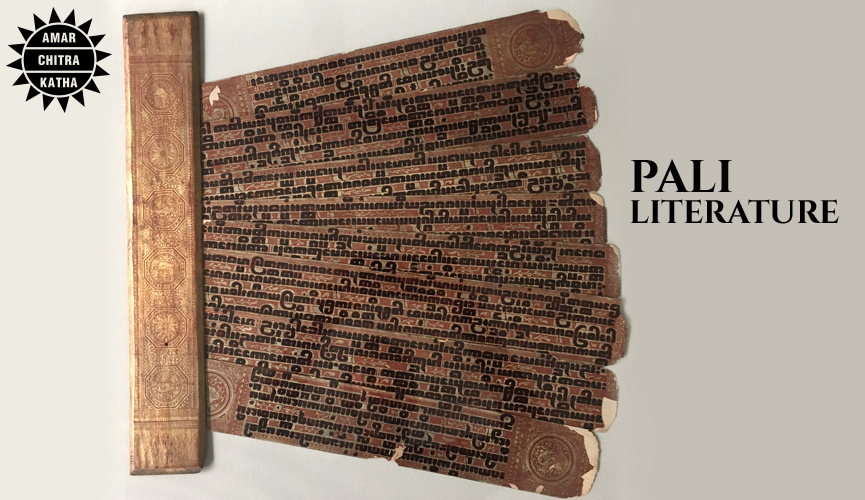
Religious and mythological texts have become vital mediums that act as a link between us and the gods that we believe in. In Buddhism, this role is fulfilled by the Pali school of literature. Primarily concerned with the Theravada sect of Buddhism, Pali literature became significant to the religion as it spread from India to other South-East Asian countries such as Burma, Sri Lanka, Thailand and Cambodia. Pali is the traditional language in which most of these works have been written and orated in. 

How did Pali originate?

The word Pali simply means ‘a line’ and is regarded as a Middle Indo-Aryan language that is native to India. The earliest known origins of this language are unclear, but it is believed that it began in the kingdom of Magadha in the early 17th century. It was earlier known as Magadhi, named after its place of origin in modern-day Bihar. As the language began to travel through the different regions of the country, slowly spreading to the rest of the continent, it was renamed as Pali, a language which the Theravada Buddhists believed was spoken by Buddha himself. 

DID YOU KNOW?

Experts believe that Buddha did not teach his disciples in Pali but an earlier variation of Magadhi. The exact language used by Buddha is still unknown!

Image: Wikipedia | Design: ACK Design Team
Types of Pali literature

To understand the origins of Pali literature, one has to first understand the structure of Buddhist scriptures or the Tripitaka. Tripitaka loosely translates to the three-fold basket of teachings indicating the three broad parts it covered, namely:

  • Vinaya Pitaka (The Basket of Discipline) dealing with monastic and royal administration
  • Sutapitaka (The Basket of Sayings) which consists of long discourses that is believed to have been taught by Buddha to his disciples
  • Abhidhamma Pitaka (The Basket of Dharma) that consists of several philosophical and psychological work

Interestingly, each Buddhist subsect had its own tripitaka for its monasteries written by its sangha, penned down across 32 books. The earliest forms of Pali literature are based on the tripitaka of the Theravada Buddhists. Initially, these stories were passed down from generation to generation through oral recitation. It is only during the time of Ashoka that the script came into being. Some of the best works of Pali literature are Dipavamsa, Mahavamsa, and Culavamsa, which are chronicles about the history of Sri Lanka.

The Jataka Tales

While most of us see the Jatakas as ancient Indian folk stories, they actually have religious significance for the Buddhists. The Jatakas were a collection of stories said to be based on Buddha’s past lives consisting of his human and non-human avatars, and are considered an integral part of Buddhist learnings. These stories highlight the rewards of practising Buddhist virtues and morals that ultimately lead to enlightenment or moksha, freeing the soul from the endless cycle of birth and death. 

The Jatakas were originally written entirely in Pali and consist of nearly 500 tales in the Sutta Pitaka. Before they were written down, the Jatakas were also shared orally. Sharing stories, fables and anecdotes was the most popular form of preaching religion in the olden days, and with its inclusion of including folk and local elements, the Jataka tales were a huge hit amongst Buddhist teachers. 

Pali literature in South-East Asia

Circa the 3rd Century BCE, the great Mauryan emperor Ashoka sent his son, Mahinda, as an ambassador to propagate Buddhism in the neighbouring island of Sri Lanka. Pali literature became instantly popular in the country, where the Theravada community grew in large numbers. Between the 5th and 6th centuries, an important piece of Pali literature called Visuddhimagga or “The Path of Purification” was published, written by the famous Buddhist scholar, Buddhaghosa. 

Soon, Buddhism started spreading rapidly across countries in South-East Asia. The philosophical commentaries on life and the simplicity of its teachings made the religion wildly popular especially in Burma (Myanmar), Thailand, Sri Lanka, Japan, Nepal and China. More traditional Buddhist communities began adopting Pali as their language of choice for religious sermons and teachings. Numerous works in the language were published and widely circulated. 

However, the ancient language could not stand the test of time, with its significance now limited to very few countries. Sri Lanka still continues to be one of the only standing Buddhist communities that actively studies Pali, and the language has been taken up for research by several Western and European countries. However, despite its waning popularity, its innumerable works even today contain many clues to the secrets of Buddhism and Buddhist history. 

Read Amar Chitra Katha’s retelling of the Jatakas, now available on the ACK Comics app, Kindle and various other platforms.

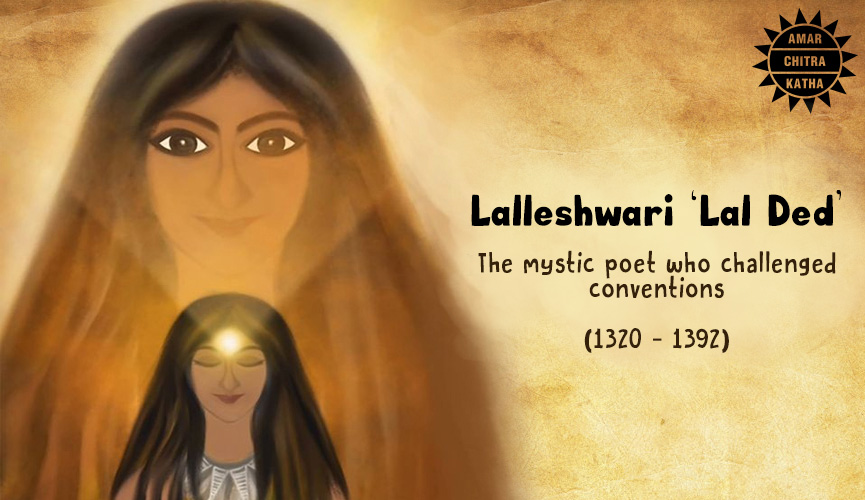
Who was Lalleshwari?

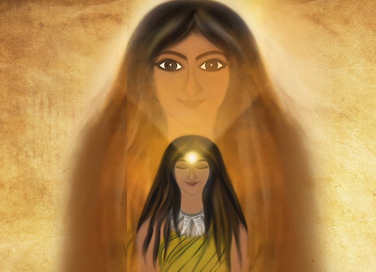
Lalleshwari, popularly known as Lal Ded, was a poetess who lived in 14th century Kashmir. She belonged to the Kashmiri Shaivite sect and was also considered a Sufi saint.

Illustration: Upasana Govindarajan

Married when she was 12, she was ill-treated in her husband’s house and walked away at the age of 24 to become a devotee of Shiva.
Her mystic verses, called Vakh, have influenced generations to shun the path of rituals and tradition and to embrace the Divine as a path to self-realization. Vakh is traced to be one of the earliest composition in the Kashmiri language, making it a crucial building block of Kashmiri literature. Here is one of her popular verses.

OCEAN AND THE MIND OF MAN ARE BOTH ALIKE


Under the ocean’s bottom lies
the destructive fire, vadvaagni;
And in the breast of man doth rage
the fire of wrath.
When the fire breaks out, its flames
of angry, abusive words,
sear and scorch and burn.
But if one ponders unruffled and calm,
and weighs the words, though angry they be,
They have no substance, no, nor weight.

– Lalleshwari

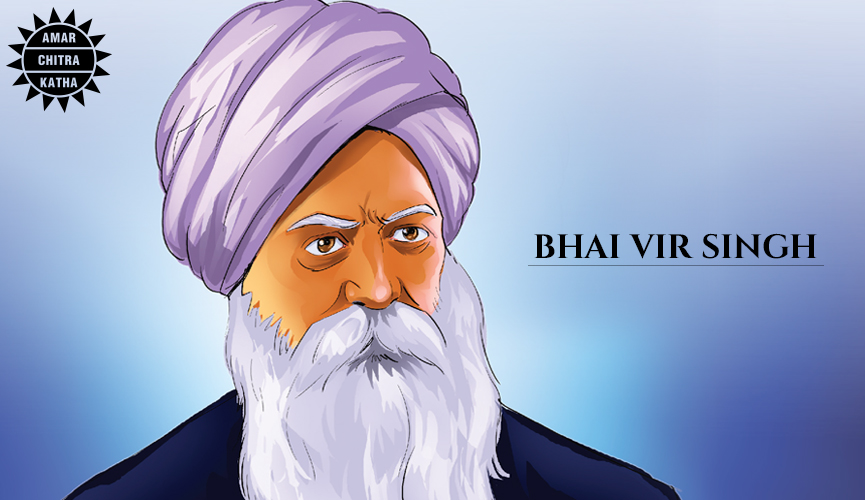
Who was Bhai Vir Singh?

Illustration: Sundara Moorthy

Bhai Vir Singh was born in Amritsar on December 5, 1872. He was a great poet and scholar and played an active part in the movement to revive the Punjabi literary tradition. Unlike many other young men of his time, Bhai Vir Singh did not take up a government job after he had completed his education. He chose to be a writer and set up a lithograph press with one of his father’s friends, Wazir Singh. He soon started taking an active interest in the Singh Sabha movement. The main aim of this society was to increase awareness among people in the teachings of the Sikh gurus and to promote the Gurmukhi script.

Illustration: ACK Design Team

Bhai Vir Singh started the Khalsa Tract society in 1894 to promote the interests of the Sikhs. The society brought a revolutionary change in the literary scene in Punjab. The members started a low-cost publication called Nirguniara, which highlighted Sikh history and philosophy. Bhai Vir Singh used this as an effective platform to express himself.

Illustration: ACK Design Team

Bhai Vir Singh’s first novels were romances. They emphasised courage and morality. Some of his novels in this genre were Sundari, Bijay Singh and Satwant Kaur. His novel Baba Naudh Singh was serialised in Nirguniara from 1907 onwards and published in book form in 1921. Bhai Vir Singh also wrote poetry. Some of his famous poetic works are Dil Tarang, Lahiran de Har and Matak Hulare. Bhai Vir Singh was honoured with the Sahitya Academy Award in 1955 and the Padma Bhushan in 1956. He died in Amritsar on June 10, 1957.

Read our take on popular Indian literature in Amar Chitra Katha’s Great Indian Classics, available on the ACK Comics app and Kindle, as well as Amazon, Flipkart, and other major e-tailers.  

What are the Navarasas?

ccording to India’s performing arts traditions, the navarasas are the nine emotions evoked in an audience during their experience of a dance, music or drama performance. The Natyashastra, a Sanskrit text on performing arts by Bharata Muni, mentions only eight – Shringara, Hasya, Karuna, Raudra, Veera, Beebhatsa, Bhayanaka and Adbhuta. The ninth rasa, Shanta, was later taken from the Abhinaya Darpana by Nandikeshwara.  

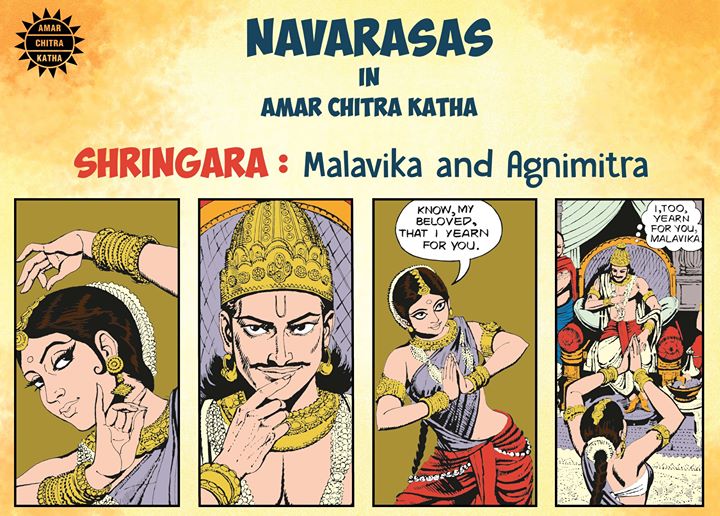
Shringara – Romantic Love
Title: Malavika | Illustration: P.B. Kavadi

Malavika, the princess of Vidarbha, had won the heart of King Agnimitra, disguised as the queen’s maid in his kingdom. During a dance performance in the court, Malavika reciprocates his feelings through her performance, a performance that very clearly vocalises her romantic intentions to the reader as well.

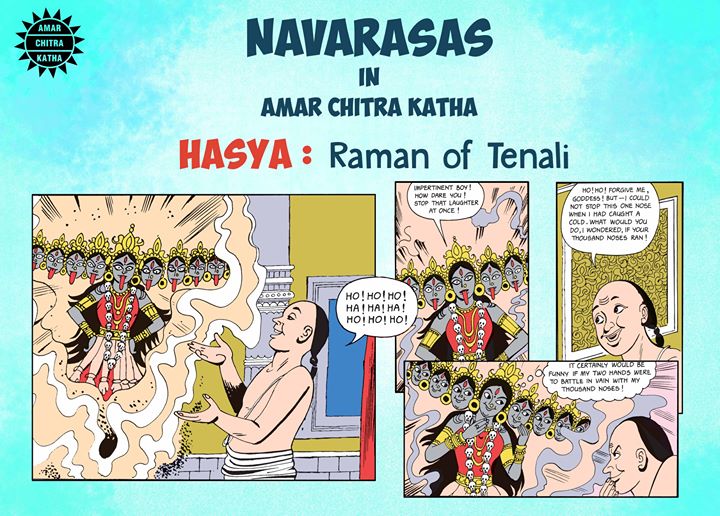
Hasya – Humour
Title: Raman of Tenali | Illustration: Ram Waeerkar

Raman of Tenali used to be quite the lazy young man. Once, when a sadhu told him to find some work, he lied saying that his ill health forbid him from working. The sadhu then taught him a mantra to invoke Kali and seek her blessings. Raman reached the temple and began to pray. When the goddess appeared before him, she was amused by his witty charm and granted him the title ‘Vikatakavi’, a palindrome in Telugu for ‘clown-jester-poet’. Tenali’s exploits are the very definition of hasya.

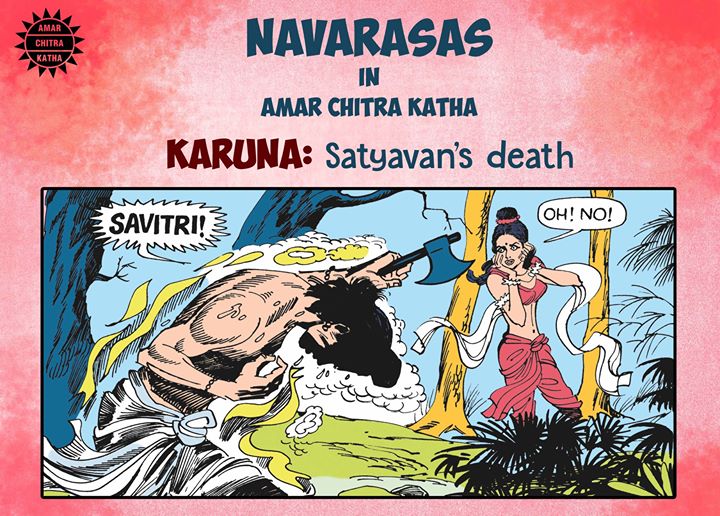
Karuna – Compassion
Title: Savitri | Illustration: Ram Waeerkar

Princess Savitri married Satyavan who was destined to die within a year of their marriage. On a fateful day, when they were in the woods collecting firewood, a sharp pain pierced through Satyavan’s limbs and he fell down unconscious, invoking in the reader a sense of compassion for the now-widowed Savitri.

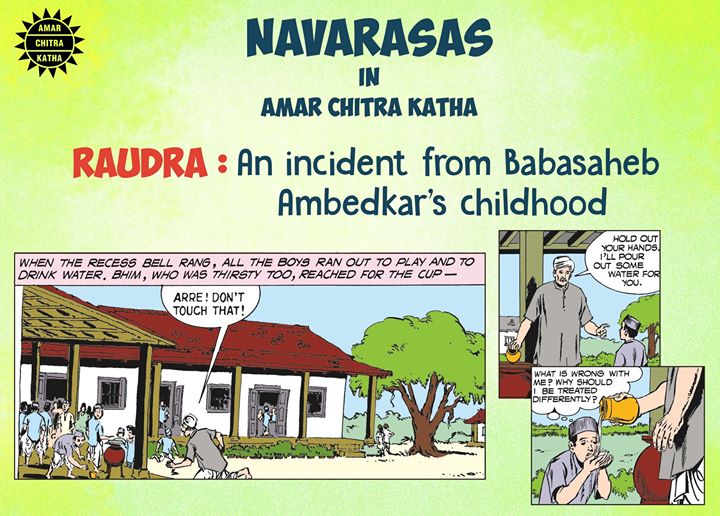
Raudra – Rage
Title: Babasaheb Ambedkar | Illustration: Dilip Kadam

Babasaheb Ambedkar was born in a Mahar family, a caste that was treated as untouchable. When he joined school, he was treated differently from his peers who belonged to the upper castes. He was made to sit on the floor, while his classmates sat on benches. He was also not allowed to touch the pot of water that was kept for the students, instead was forced to sip it from his hands as the teacher poured the water out for him. All of this deeply hurt young Ambedkar and angered him, and angers the audience in turn.

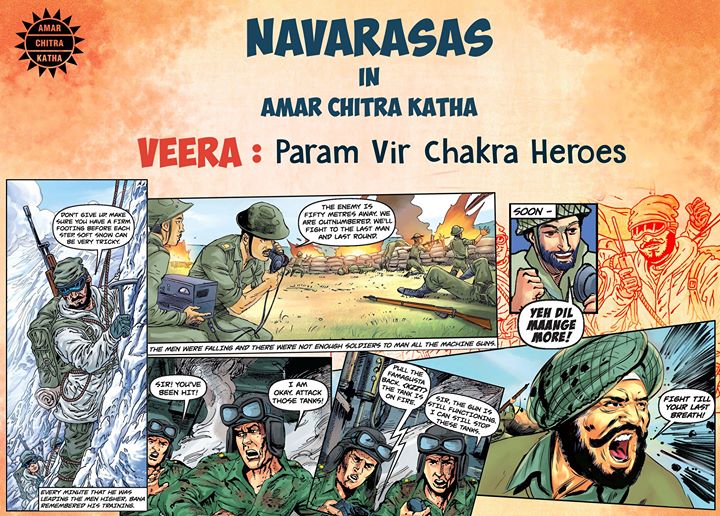
Veera – Valour
Title: Param Vir Chakra | Illustrations: Durgesh Velhal, Sabu Sarasan, Arijit Dutta Chowdhury and Harsho Mohan Chattoraj

The Param Vir Chakra is the highest military honour given to the soldiers of the Indian Armed Forces. This medal has been awarded to 21 officers for their unwavering courage and spirit of sacrifice even in the face of great adversity. All the stories in this collection inspire the audience with the absolute bravery on display by these real-life heroes.

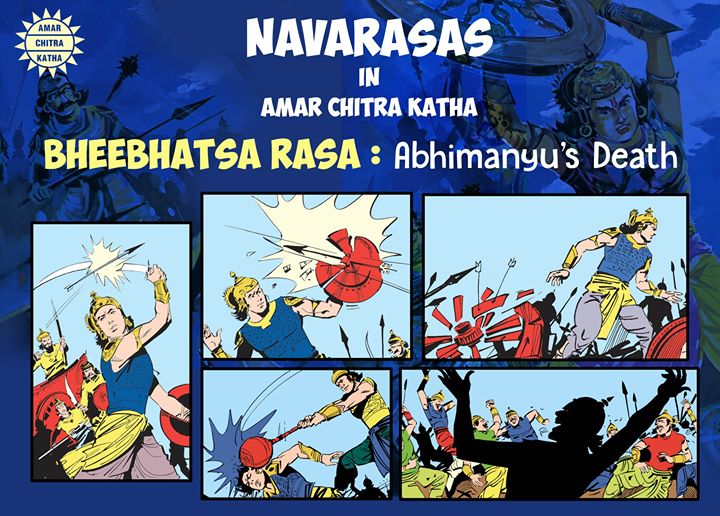
Beebhatsa – Disgust.
Title: Abhimanyu | Illustration: Pratap Mulick

When 16-year-old Abhimanyu was trapped alone inside the chakravyuh, a circular battle formation, he was attacked from all sides. With his weapons broken and him rendered unconscious, he was finally killed with the blow of a mace. The Kaurava army rejoiced as the young boy lay dead. The entire incident fills the reader with a deep sense of sorrow for the boy and utter disgust at the Kauravas and their callous behaviour and ruthlessness.

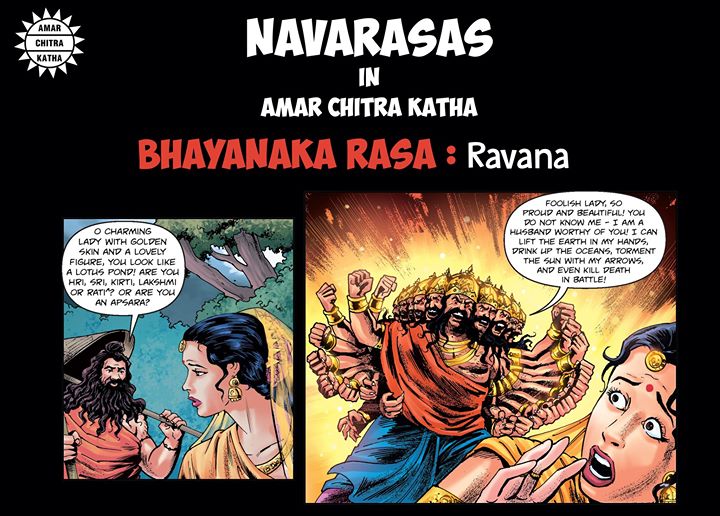
Bhayanaka – Fear
Title: Valmiki’s Ramayana – Aranya Kand | Illustration: Arijit Dutta Chowdhury

When Ravana came to abduct Sita, he shed his disguise as a brahmin and showed himself in his true form as the fearful ten-headed demon king, filling both Sita and the reader with horror!

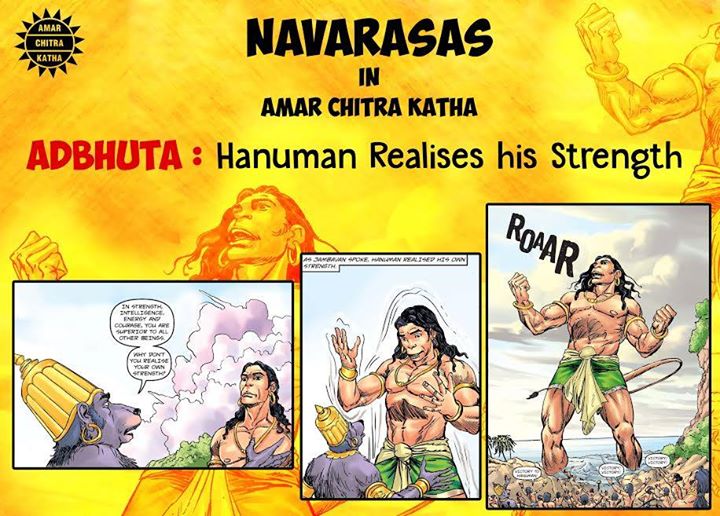
Adbhuta – Wonder
Title: Valmiki’s Ramayana – Kishkindha Kand | Illustration: Durgesh Velhal

When Angada’s forces reached the vast ocean in their search for Sita, they were faced with a dilemma – who would be able to leap across the waters and reach Lanka? It was then that the wise bear king, Jambavan, reminded Hanuman that he was blessed with many divine boons. As Hanuman increased his physicality to gigantic proportions, it’s not just his fellow soldiers who are filled with wonder at their comrade’s size, but also the reader. 

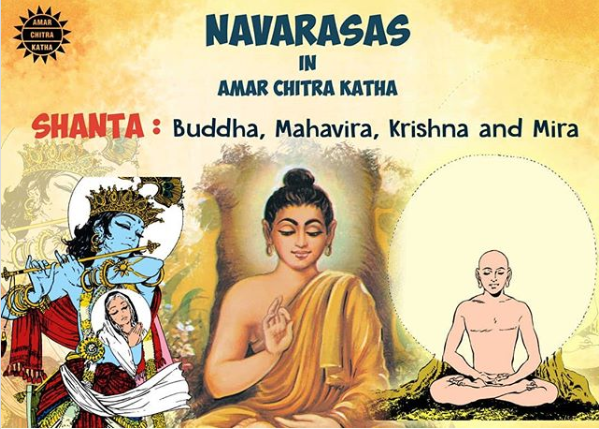
Shanta – Peace
Titles: ‘Mirabai’, ‘Buddha’ and ‘Mahavira’ | Illustrations: Yusuf Lien, P.D. Chopra and Pratap Mulick

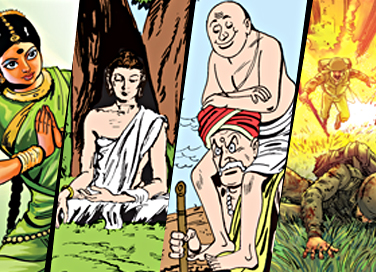
We have chosen three images from our comics that inspire this rasa in anyone reading their stories. There is Mirabai safe in Krishna’s heart after she departs from the mortal plane, Buddha at peace with himself and the universe after attaining nirvana, and Mahavira in deep meditation, oblivious to the world with all its noise and confusion.

Read all these titles and more with an ACK Comics digital subscription. Amar Chitra Katha’s books are also available on Kindle, Amazon, Flipkart, and other major e-tailers.

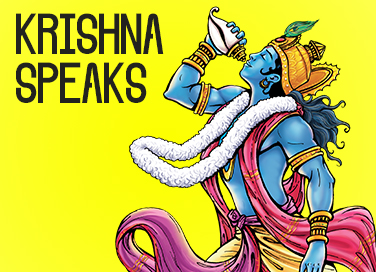
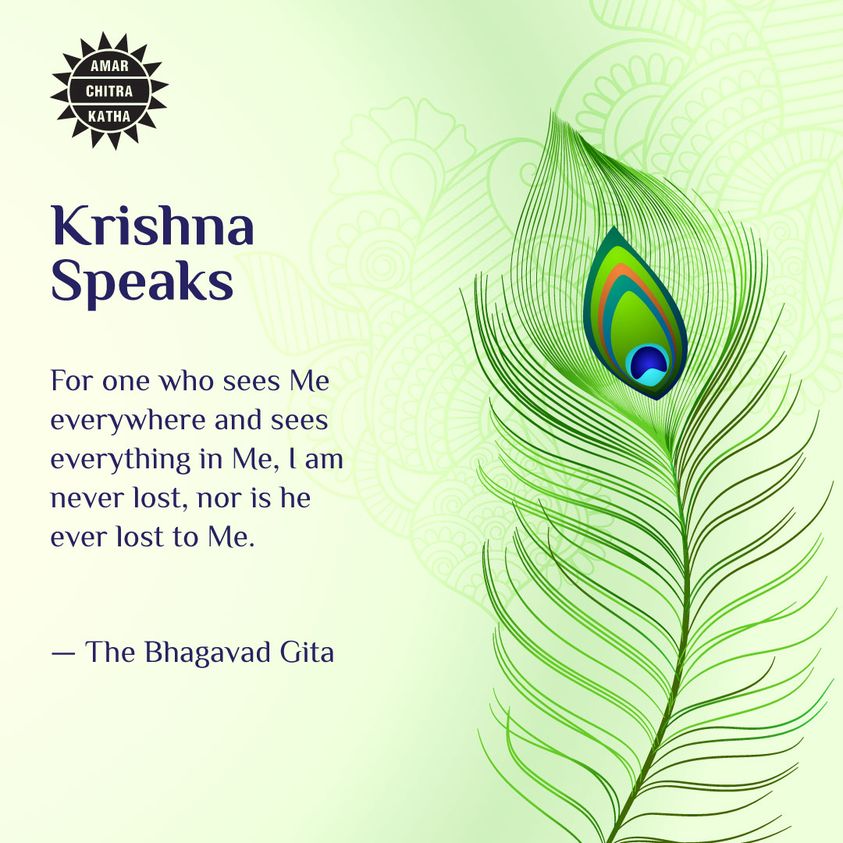
Krishna Speaks #5

Krishna says that the lord is present everywhere. One who understands this will always find solace and comfort, no matter how dire and bleak the situation seems to be.

Illustration: ACK Design Team

Writer Write-Up: Deepa Balsavar

Deepa Balsavar is a writer, illustrator and educationist, who has many award-winning books to her name such as ‘The Seed’ and ‘The Lonely King and Queen’. She has spent many years working on putting together material for a variety of educational programs including UNICEF’s empowerment series for children as well as the Avehi-Abacus Project. 

Deepa’s love for words and pictures started at the tender age of five when she could first make out what a stop sign said on a road trip with her family. Even as a kid, she would spend many nights wide awake, her nose glued to her book. Through her work, she now aims to invoke that love and passion for the written word in as many as kids as possible.  

Nani is a popular character among kids who Deepa created as a composite of all the people she is truly fond of and all the values that are important to her. Her latest Nani adventure ‘Nani’s Walk to the Park’ not only highlights these values but also helps kids discover everything that is Mumbai. From travelling in the double-decker bus to looking at piles of lychees on a fruit vendor’s cart, the book helps kids explore the real Mumbai, encouraging them to find beauty in their own surroundings. Deepa finished the book in record time too, working long hours in the day to meet her deadline.

“From the final story being given in to the final approval, the book was completed in four months which is nothing. I worked on the book for 12 to 13 hours a day, but I really wish I would have given a few more months to the book. Now when I look at it, I feel there is so much more that I could have added to it.”

The phenomenal writer also finds beauty in scrap and tatter. She is a fabulous papier-mâché artist. Her 3D models are the definition of cute and have developed a cult following. 

“I want to learn to make stuff without using any kind of chemicals and reusing all kinds of waste that I can find around at home. I use all of those to make these 3D art models of various things that I get inspiration from.” 

Watch the video to listen to Deepa read an excerpt from her book ‘Nani’s Walk To The Park’ and learn more about her journey. 

#ACKandFriends is an online talk show by our Amar Chitra Katha editorial team, where we connect with India’s top children’s authors and give audiences a sneak peek into the creative process behind writing books for kids. Watch Season 1: Click here 

Stay tuned for Season 2 coming soon.
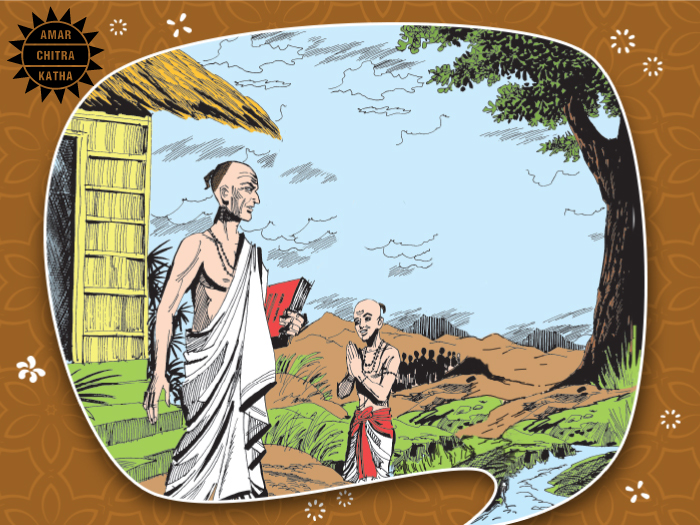
Who Wrote The Panchatantra?

Illustration: Pradeep Sathe

A long time ago, there was a king called Amarashakti. He ruled the kingdom of Mahilaropyam in southern India. He had three sons, Bhaushakti, Ugrashakti and Anantashakti, who were not the sharpest tools in the shed. This was something the king wanted to change, so that they would become worthy of ruling the kingdom someday. However, there was very little hope of this happening, as the three princes were quite averse to the idea of learning.

One day, the king heard of an Indian scholar named Vishnu Sharma. With hope in his eyes, the king approached him and asked if he would take on his sons as his students and teach them some valuable life lessons. Vishnu agreed to the king’s plea and promised to educate them in six months. When Vishnu started the princes’ education, he quickly realized that traditional modes of teaching will not work with them, given their rather limited attention span and tendency to get bored easily. So, in order to make them learn, Vishnu Sharma decided to leverage the power of storytelling. He wrote down simple moral stories, segregating them into five books that he called the Panchatantra, pancha meaning ‘five’ and tantra meaning ‘principles’. 

Illustration: Pradeep Sathe
Book One: Mitra-bheda – The Loss Of Friends

The longest of the five books, this book contains thirty fables. They talk about the importance of the different causes that lead to breaking up of even the strongest of friendships.

Book Two: Mitra-labha – The Winning of Friends

This series contains ten fables, which convey the importance of allies. It shows how the right friendships can circumvent all odds and help us prosper in life. 

Book Three: Kakolookiyam – On Crows And Owls

Comprising 18 fables, this series focuses on war and peace. The stories underline how a battle of wits is mightier than a battle of swords. 

Illustration: Pradeep Sathe
Book Four: Labdhapranasam – Loss Of Gains

This book contains 13 fables and is in complete contrast to the first three books. If the first three books talk about ethical behaviour and what to do, the fourth book and its successor talk more about negative personality traits and what not to do.

Book Five: Apariksitakarakam – Ill-Considered Actions

With 12 fables inside, this book talks about the ill-effects of decisions taken in haste. 

Every story in this collection spoke about different moral values that an upstanding citizen would abide by. His stories were so powerful, even today, millennia later, the lessons conveyed in each of these can be easily applied to various real-world situations. As for the three princes, they were so enamoured by Vishnu Sharma’s stories they inadvertently ended up learning a lot, fulfilling their father’s wish of becoming dependable leaders.

Read the vivid retellings of Panchatantra tales from our huge digital library now accessible on the ACK Comics app and Kindle. 

Profile: Salman Rushdie

By Nitya Menon         

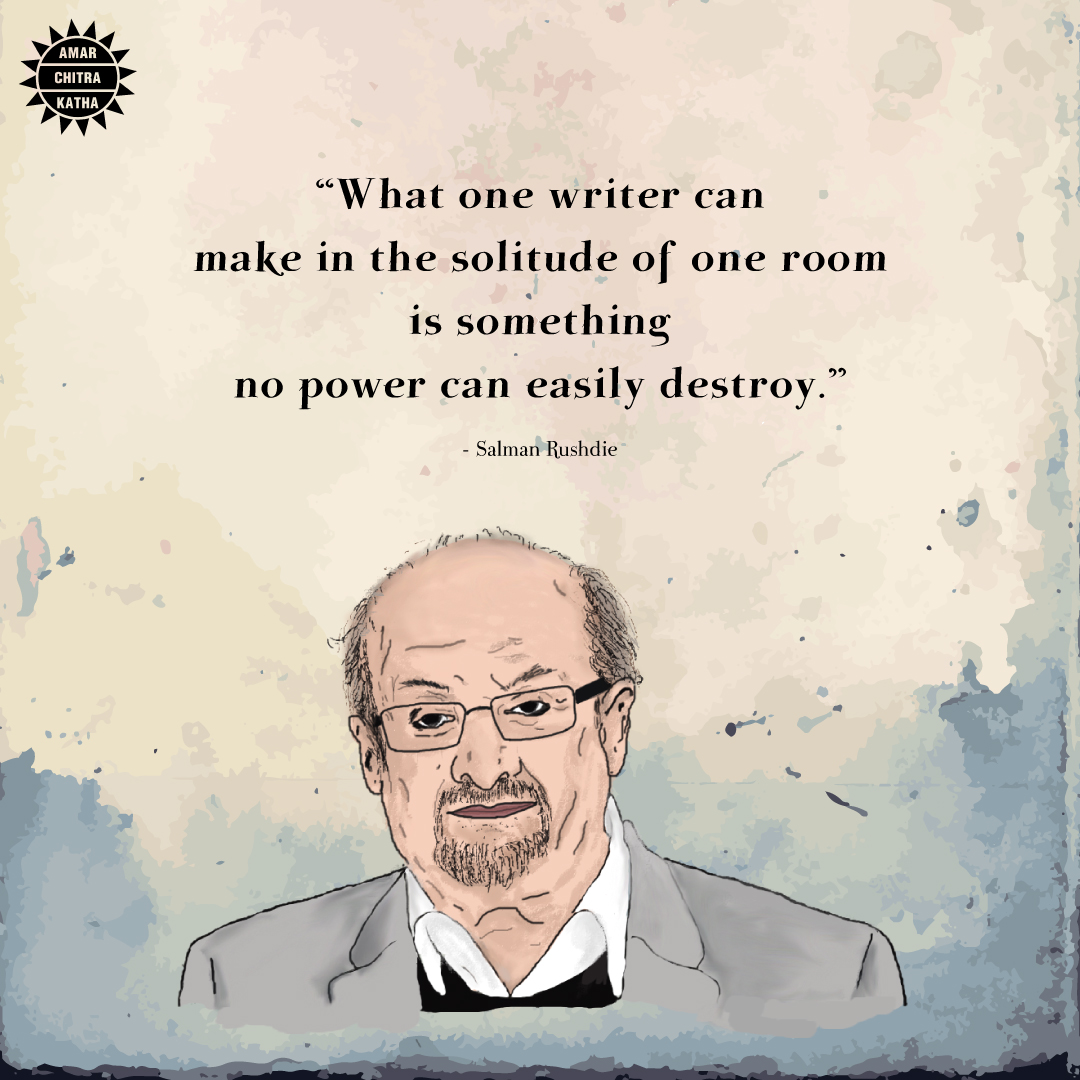
Illustration: Mala Narwani

Salman Rushdie is a storyteller and the author of 13 novels including the critically acclaimed Midnight’s Children and the highly controversial The Satanic Verses. He has contributed to literature in a big way, while always standing by his beliefs and maintaining his firm stand on the necessity of free speech and expression.

Born on 19 July 1947, he studied in Cathedral and John Connon School in Bombay, and further went on to study History at King’s College, Cambridge. He then moved to Pakistan with his family in 1964 where he worked in television for a while, later moving back to England to work as a copywriter for an advertising agency. During this time, he started working on his first novel Grimus which was published in 1975. Even though the response to his first novel was not overly enthusiastic, he continued to write, publishing his second novel, Midnight’s Children, which created history by winning the Booker Prize for Fiction and the James Tait Black Memorial Prize. 

Salman Rushdie’s style of writing is a combination of magical realism and historical fiction. His books mostly involve connections, disruptions, and migrations between Eastern and Western civilisation. 

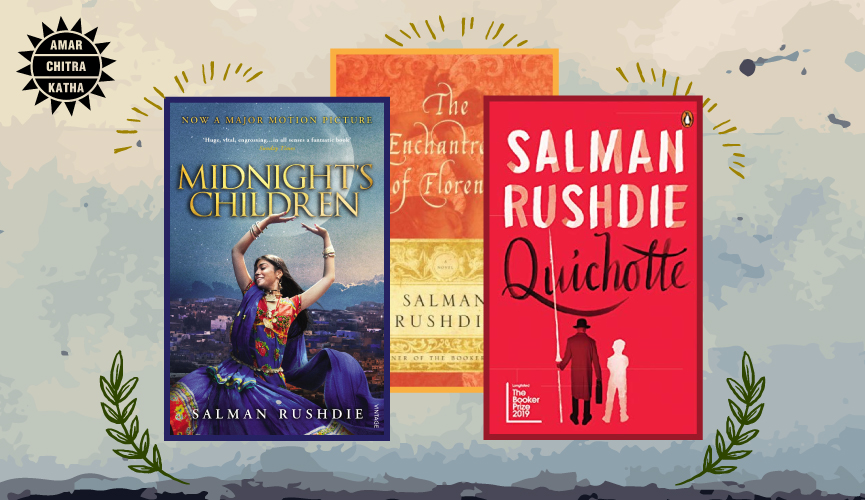
For example, Midnight’s Children is about the life of a child born at the stroke of midnight as India gained its independence, who is gifted with special powers and has a connection to other children born in this new age and the birth of a modern Indian nation. Shame, which was published in 1983, talks about the political turmoil in Pakistan. Then there’s The Satanic Verses, which depicts the identity crisis and alienation due to migration from India to the west. This book earned him the ire of Islamic fundamentalist groups, with a fatwa being issued against him.

Covers: Amazon | Design: ACK Design Team

However, Rushdie was unfazed as he firmly believed that the production of art requires the confidence that an artist can freely express the vision that is in him, without suffering retaliation from society. He is often questioned on how he reacts to criticism against his literary works and he says that the best answer to someone trying to silence your voice is to speak with greater confidence. If offence becomes a criterion that prevents the expression of a certain idea, then there will be no expression. He believed there were other dangers, such as unnecessary self-censorship and excessive anger that would lead to revenge books, viewing both as ultimately self-destructive.

As an accomplished author, his message to young writers is that you wake up every day with a nudge of creative juice and you can either choose to use it or waste it. 

“One must always imagine a novelist as a long-distance runner, and there’s a marathon. With no means is the marathon runner more gifted than a sprinter, but it’s just the kind of athletics where one has to chip away and let the mark post get by, and trust that, one day, the finish line will come.”

During the course of his career, Rushdie has received many awards such as the Golden Pen Award, Outstanding Lifetime Achievement Literature Award (Harvard University), Booker Prize for Fiction, Commonwealth Writers Prize and many more.