


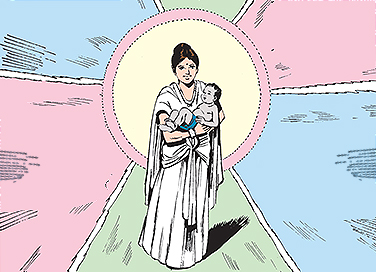
Kunti – The Mother of the Pandavas and Karna

Kunti was the first-born child of Shurasena, a Yadava ruler. She was the sister of Vasudeva, Krishna’s father, the wife of Pandu and the mother of Karna and the Pandavas. Here are some lesser-known stories from the life of Kunti.   

Buy the Complete Mahabharata today

Birth and childhood of Kunti

Born as the daughter of Shurasena, a Yadava ruler, Kunti was named Pritha at birth. Shurasena gave his first-born child to his childless cousin, Kuntibhoja, due to a promise he’d made earlier. In her new home, Pritha came to be known as Kunti. Later, Arjuna also came to be known as Parth since he was the son of Pritha. As a maiden, Kunti served Sage Durvasa with reverence. Pleased with her hospitality, he gave her a special boon, due to which she could summon any celestial being of her choice in order to beget children from them.  
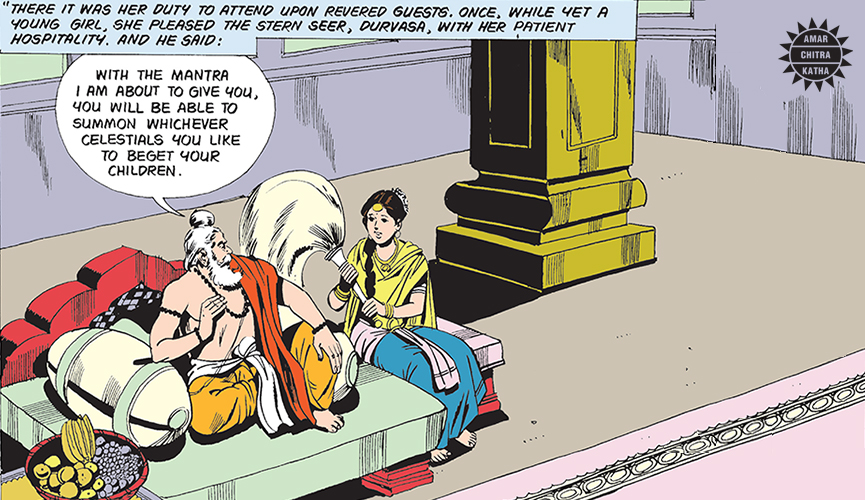
Script: Kamala Chandrakant; Illustration: Subba Rao and TNP Nedungadi
Buy the Complete Mahabharata today

Penance for Arjuna

After the birth of Yudhishthira and Bheema, Pandu wanted a son who would win the admiration of the world. Pandu wanted to invoke Indra, to obtain a son from him. Hence to gratify Indra, Pandu suggested a year-long observance for Kunti. He also observed dire penances and mediation, standing on one leg from sunrise to sunset. Pleased with their penance, Indra came to Pandu and said he would give him a son who would be famous in all three worlds. As soon as Arjuna was born, Kunti heard voices from realms that addressed her. The voices said that this invincible child of hers would make her famous. The voices added that her son would win the admiration of Shiva in combat. Hence, he would obtain the Pashupatastra from him. 

Madri’s wish

Following the death of Pandu, Kunti told Madri, Pandu’s second wife, that she would follow Pandu in death as she was his first wife and asked Madri to take care of her children. However, Madri, full of grief, told her that if she survived, she would not be able to rear Kunti’s children as her own. Madri was convinced that Kunti would raise all the children with equal affection. Madri also added that since she was the cause of Pandu’s death, it was her wish to leave the world with her husband. With these words, Madri ascended the funeral pyre of her husband. 

Buy the Complete Mahabharata today

Role in Bakasura’s death

After their escape from the forest of Varnavrata, the Pandavas went into hiding and lived in disguise in the house of a Brahmana family in a village named Ekachakra. One day, Kunti noticed that the family was distressed and weeping due to the misfortune that had befallen them. When asked the reason, they explained that a rakshasa named Baka was protecting their land and in return, demanded a meal of a cartload of rice, two buffaloes, and also the man, who took them to him, as his food. Kunti consoled the family and ordered Bheema to take the food to Baka, instead of one of the members of the family. When Yudhishthira questioned his mother about sending Bheema to the rakshasa, Kunti said that she assigned this task to Bheema as she was aware of his strength. She also added that it is the duty of a Kshatriya to protect those in distress. As expected, Bheema killed Bakasura, thus ending his tyranny.  
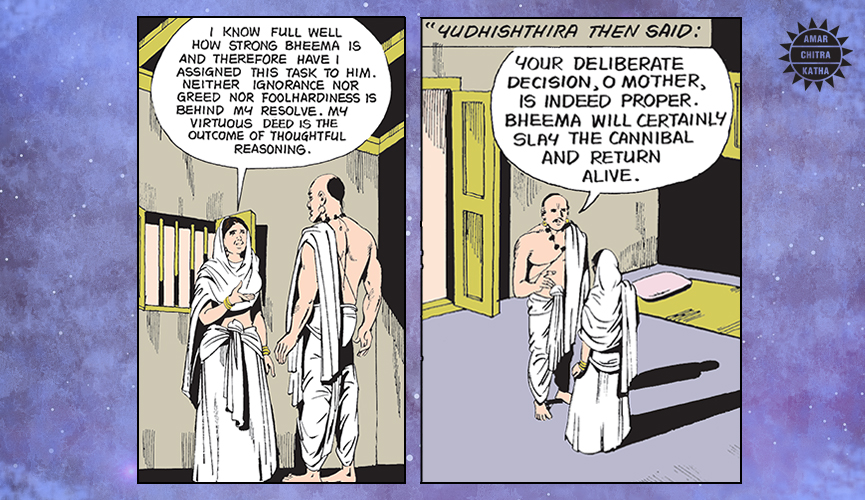
Script: Kamala Chandrakant, Illustration: TMP Nedungadi
Kunti’s message before the war

When Krishna visited Hastinapura as an envoy to make a peace offering on behalf of the Pandavas, he was given a warm welcome at the court. After exchanging some pleasantries with the Kauravas, Krishna went to visit Kunti, his paternal aunt. Kunti asked about the well-being of her sons and daughter-in-law. She told Krishna to convey her message to her sons. Kunti declared that the time had come for them to show themselves as true Kshatriyas. She added that if they failed to uphold Dharma now, she would forsake them forever. 

Retirement

After the coronation of Yudhishthira, Gandhari and Dhritarashtra decided to retire to the forest. But when the couple emerged from the palace, the Pandavas were surprised to see Kunti leading their way. Surprised Yudhishthira asked Kunti how could she leave them now when she was the one who encouraged them to fight for the throne. Kunti calmly replied that whatever she did so far was for the welfare and safety of her sons. Now that they were secure, she decided to follow Gandhari and Dhritarashtra on their last journey. Accompanied by Vidura, Sanjaya, Dhritarashtra and Gandhari, Kunti left Hastinapura to spend the rest of her days in the forest. 

Buy the Complete Mahabharata today

The last days

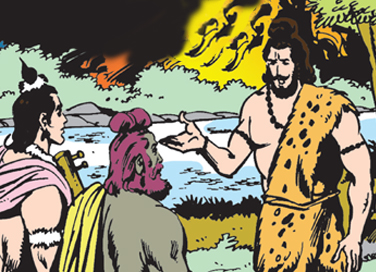
Kunti and Gandhari, with Dhritarashtra, spent their days in the forest in prayers and fasting. One day, a storm broke and with it, a forest fire. Vidura had already passed, but the trio persuaded Sanjaya to escape as they had become too weak and helpless to run away from the fire. Sanjaya reached the Himalayas. Unfortunately, Gandhari, Dhritarashtra, and Kunti were consumed by the forest fire. 

Read the Mahabharata collection by Amar Chitra Katha, now available on the ACK Comics App, Kindle, Flipkart and with other major e-tailers. 
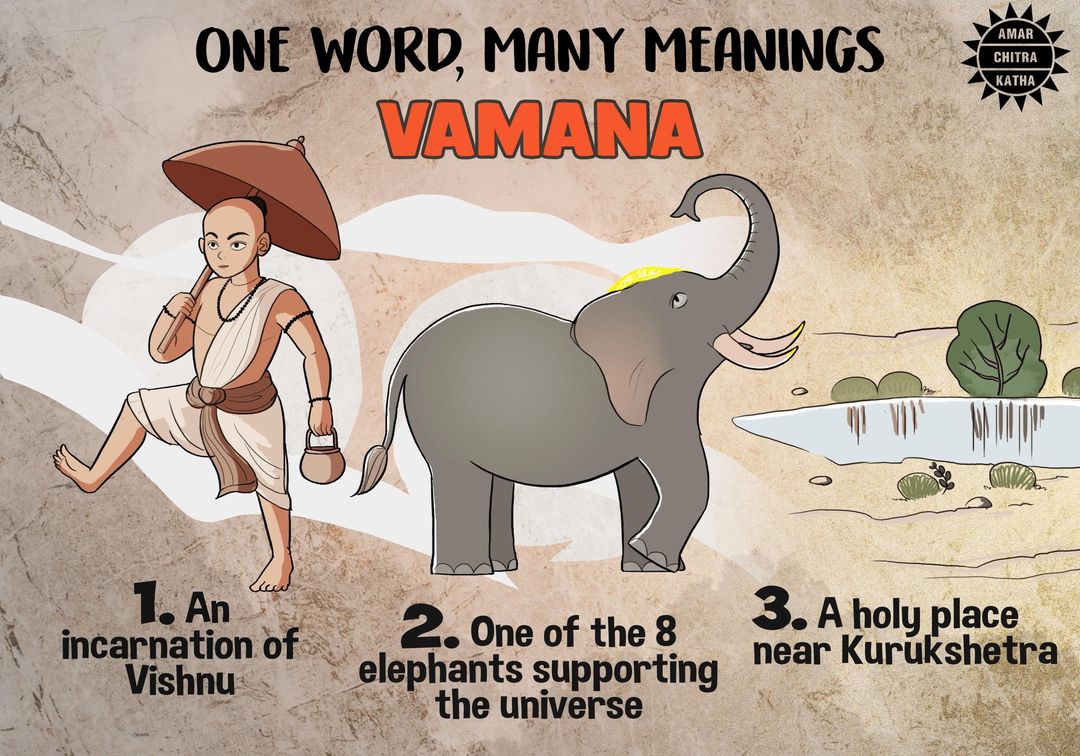
Vamana

Illustration: Sanjhiya Mayekar

The word Vamana has many references in the Puranic texts. Some of them are:

1. Vamana is the fifth incarnation in Vishnu’s Dashaavatar or ten incarnations.
2. Vamana is the name of one of the eight elephants that support the universe on their backs.
3. A holy place at the borders of Kurukshetra is called Vamana. In this place is a pond named Vishnupada. Legend says that if one bathes in it, their sins will be washed away and they will be granted entry into Vishnu’s abode.

Shakuntala, Dushyanta and the Birth of Bharata

By Srinidhi Murthy

Shakuntala was the daughter of Sage Vishwamitra and Menaka, a heavenly nymph. She was raised by sage Kanwa and married to Dushyanta, the king of Hastinapur. Later, she gave birth to Bharata, the ancestor of the Kuru clan. Her story is an important part of the Mahabharata

Shakuntala’s Birth and Childhood
Script: Dalat Doongaji and A.K. Lavangia; Illustration: P.B. Kavadi

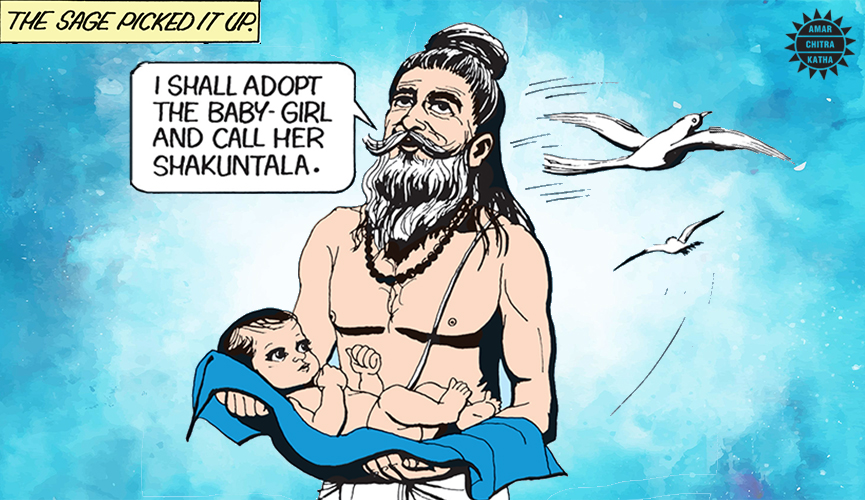
Menaka, a heavenly nymph, left her newborn baby, near the hermitage of Sage Kanwa. The baby girl was adopted by the sage and was named Shakuntala. The name Shakuntala was bestowed upon her by Kanwa as she was found surrounded by the Shakuntala birds. Shakuntala spent her entire childhood under the care of Kanwa and enjoyed taking care of the animals around her. Soon, she grew into a beautiful maiden.

The epic stories of Indian Gods and Goddesses beautifully illustrated in Epics and Mythology Collection: Buy Now

Gandharva Marriage 

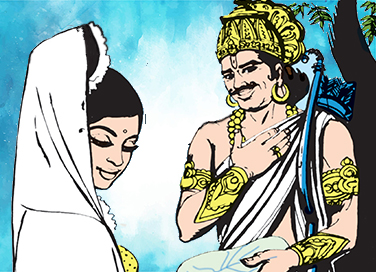
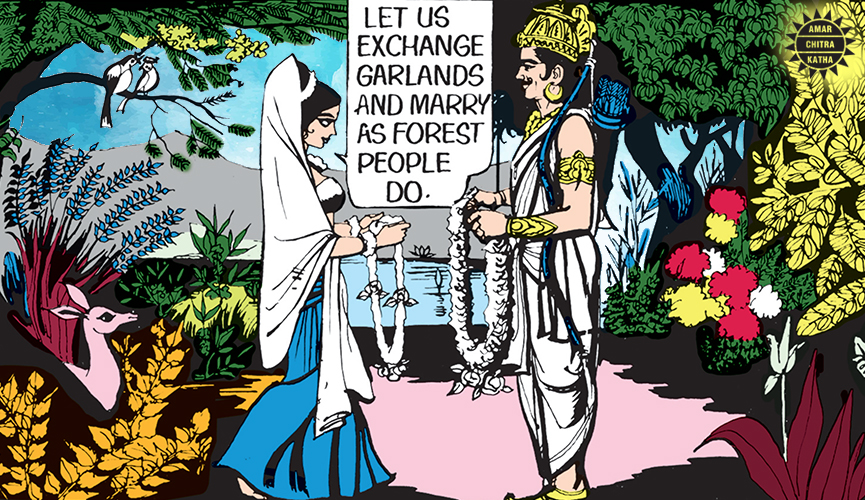
One day, Dushyanta, the king of Hastinapur, visited the hermitage of Sage Kanwa. As the sage was not there at the time of Dushyanta’s arrival, Shakuntala received him with all due honour. Impressed by her beauty and grace, the king asked her to marry him. Shakuntala asked the king to wait for the return of her father as he would be the one to bestow his blessings upon their marriage. Upon hearing this, Dushyanta suggested Gandharva marriage, which required only the sanction of those who were to marry. Shakuntala agreed to wed him through Gandharva marriage with a condition that the son, born of their union, would be declared as his heir-apparent. Dushyanta agreed to her condition and they soon got married. He then left her, with a promise to send his troops to escort her to the capital as his wife and queen. 

Script: Dalat Doongaji and A.K. Lavangia; Illustration: P.B. Kavadi
Dushyanta and Shakuntala’s son 

When Kanwa returned, he learnt about the events that happened in his absence, through his ascetic power. He was pleased with the marriage and blessed Shakuntala, telling her that her son would be mighty and illustrious. Soon, Shakuntala gave birth to a healthy boy. Six years passed since Dushyanta had left Shakuntala, with a promise of return. The son of Shakuntala and Dushyanta grew into a strong boy and showed great courage. Soon, the sage decided that it was time for the boy to meet his father. Hence, Kanwa, Shakuntala and her son started their journey toward Hastinapur.

Get the entire Mahabharata: 3 Volume Set here: link.

Dushyanta’s Rejection 

Upon her arrival, Shakuntala presented her son to Dushyanta. Though he remembered everything, Dushyanta refused to acknowledge both Shakuntala and their son. Shakuntala felt angered and hurt by his rejection. She said, “God has witnessed everything. The truth cannot be hidden. I cannot bear this disrespect. I shall return to my father’s hermitage but acknowledge and accept our son.” However, Dushyanta refused to do so. Enraged, Shakuntala stated that one day her son would rule the earth. 

The Birth Of Bharatavarsha
Script: Kamala Chandrakant; Illustration: T.M.P. Nedungadi

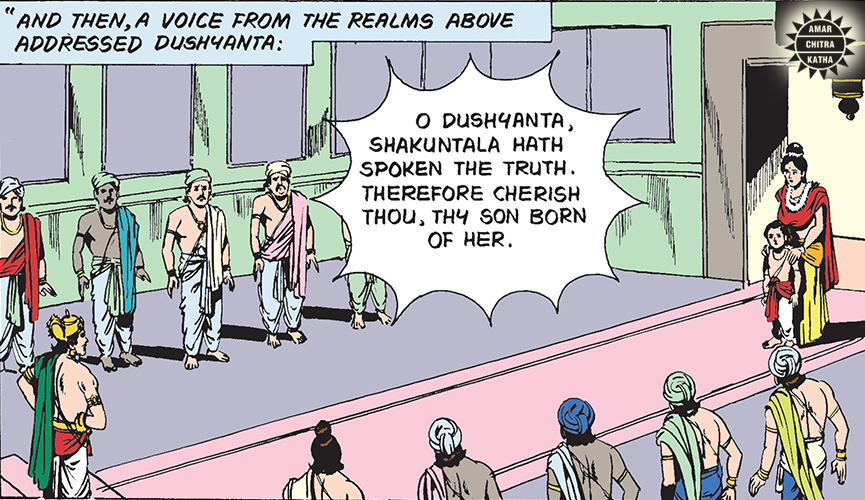
As soon as Shakuntala spoke these words, a voice from the realms above addressed Dushyanta, confirming Shakuntala’s statement. The voice then asked Dushyanta to willingly accept her and their son. Hearing those words, Dushyanta was overjoyed. Addressing the court, he said that he knew that the boy was his son. He further stated that had he accepted the boy only because of Shakuntala’s claim, his paternity would always have been questioned. Now that the celestial voice had confirmed their truth, Dushyanta happily embraced Shakuntala and their son. He named their son, Bharata and announced him as his heir. Bharata, the son of Shakuntala and Dushyanta, reigned after his father, conquering all other kingdoms, and giving birth to our nation, Bharatavarsha. 

Get the entire Mahabharata: 3 Volume Set here: link.

Nandi – The Meditative Bull

By Komal Narwani

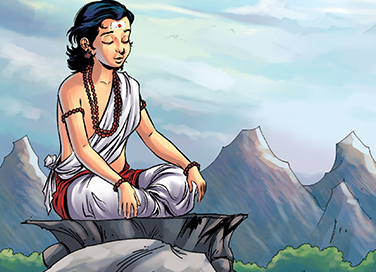
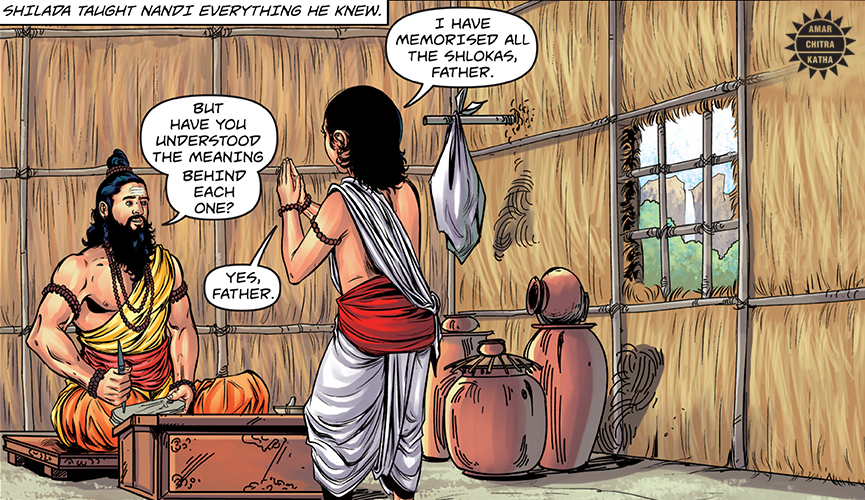
Long ago, in a small village, lived Sage Shilada. He sat in deep meditation, praying to Shiva for a child. Years later, Shiva appeared before him and blessed him. The next day, Sage Shilada found a little boy lying in the field near his ashram. Thanking Shiva for his boon, he picked up the boy and named him Nandi. 

Script: Sanjana Kapur; Illustration: Durgesh Velhal

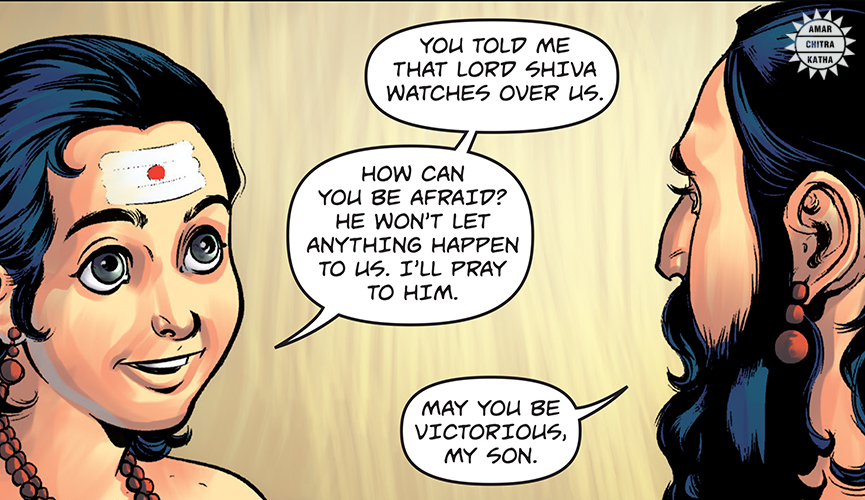
Nandi grew up to be a bright child with unparalleled wisdom. One day, two sages, Mitra and Varuna, visited Shilada’s ashram. They received a warm welcome from the sage and Nandi, who made their stay very comfortable. When it was time to leave, the sages blessed Shilada with a long life and Nandi with a happy life. The evident difference in blessings got Shilada curious. When questioned by Shilada, they revealed the bitter truth of Nandi’s short lifespan. Shilada was in tears. When Nandi learnt of this, he assured his father that Shiva would not let anything harm his true devotees. 

Script: Sanjana Kapur; Illustration: Durgesh Velhal

With his father’s blessings, Nandi left to embark on a deep devotional journey. He sat on the banks of river Bhuvana and chanted verses in honour of Shiva. Later, when Shiva asked for Nandi’s wish. He said, “O Shiva! Give me strength to chant verses in your honour for another year.” Shiva blessed him. However, after the first year, when Shiva appeared before him the second time, Nandi sought the same boon, which Shiva granted happily. The cycle repeated and formed a continuous loop until, one day, Shiva said, “Open your eyes, Nandi, you do not have to do this anymore. You are already immortal. Ask for any other wish.” Delighted, Nandi replied, “All I wish is to be at your side forever.”

Script: Sanjana Kapur; Illustration: Durgesh Velhal

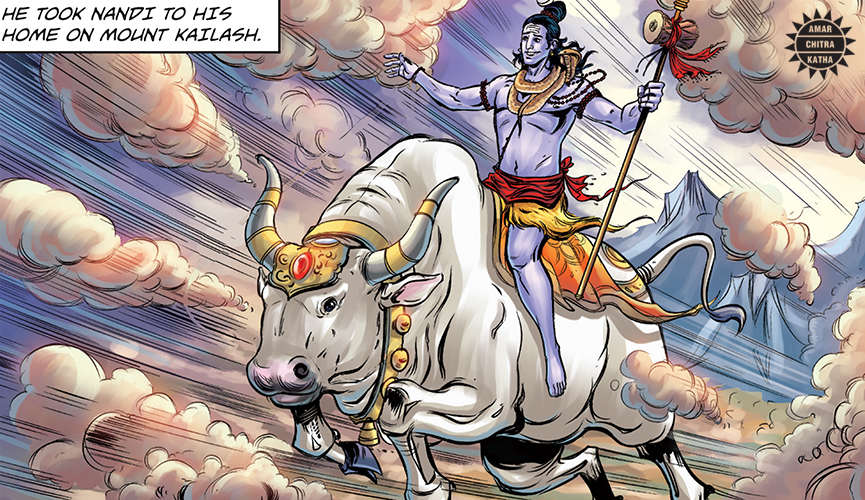
Transforming the boy into a divine bull, Shiva said, “So be it. You will be my vahana and my closest aide. Let’s head to our home, Mount Kailash.” Since then, Nandi has been Shiva’s most loyal and trusted ally. Every Shiva temple has a statue of Nandi directly in front of the main sanctum sanctorum. Nandi sits there guarding his lord through eternity. Legends say it was Nandi who taught Hanuman the hymns to praise Shiva.

Learn more about the mythological divine creatures. Read our title Divine Beings, now available on Kindle, Amazon, Flipkart and with other major e-tailers. 
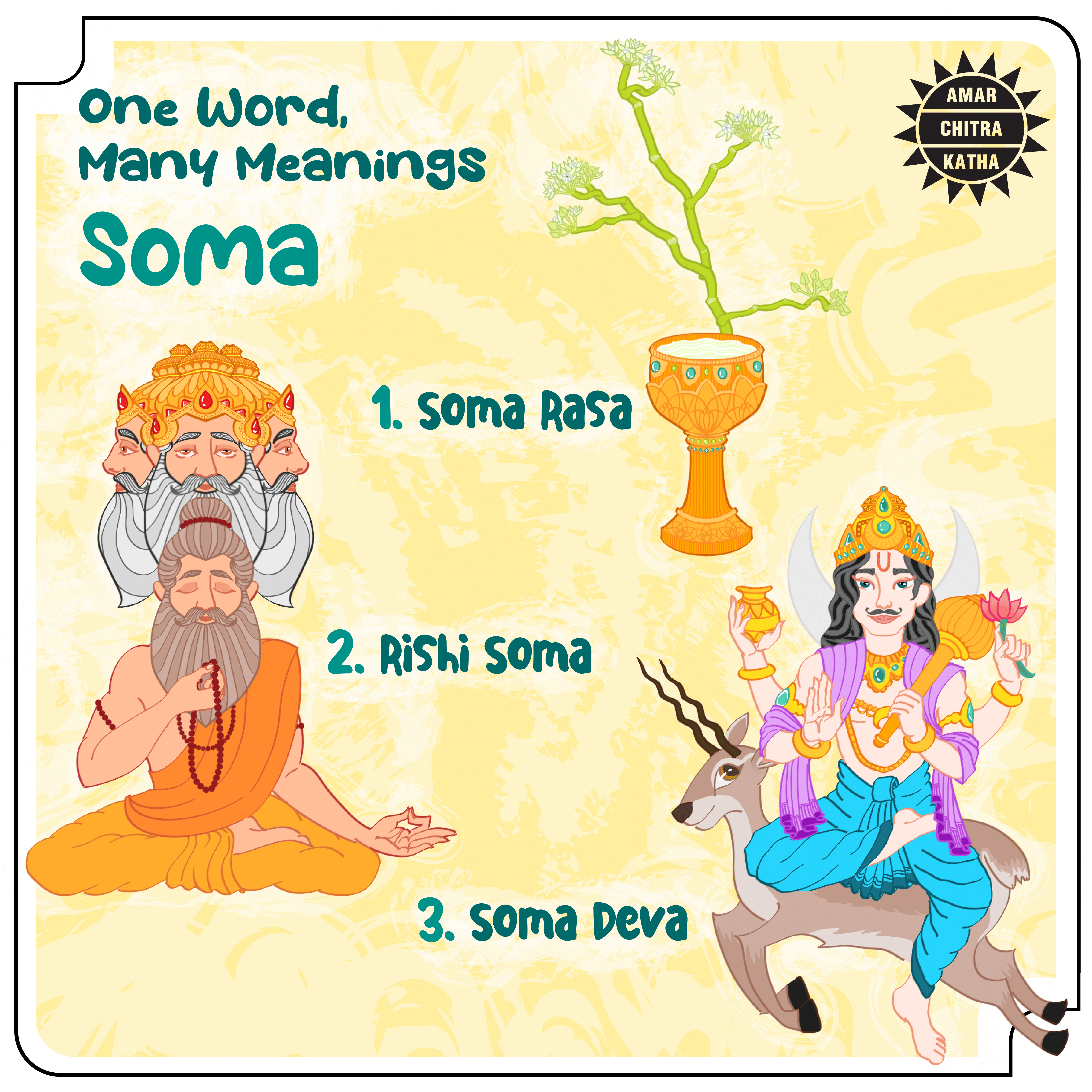
Soma

Illustration: Navya Talshilkar

The word ‘Soma’ has many references in the Puranic texts, here are some of them –

  1. The juice extracted from the Soma creeper that is consumed by the Devas.
  2. The son of Atri and Anasuya, who is said to be an incarnation of Brahma.
  3. Another name for the Moon God, one of the eight Vasus.

Ayyappan – The Son of Shiva and Vishnu

By Kayva Gokhale 

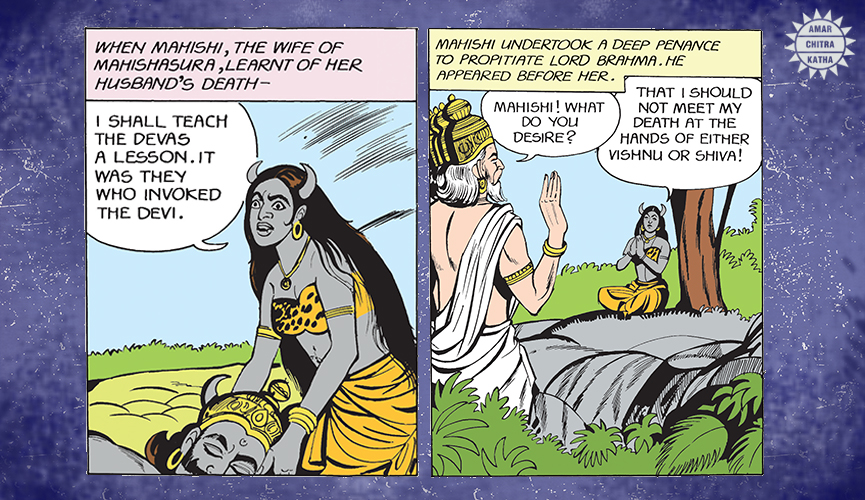
Once, a mighty demon called Mahishasura received a boon from Brahma which made him invincible against any man. In his arrogance, he did not ask for protection against a woman and so, the Gods combined their powers to create Durga, who slew Mahishasura.

Script: Shyamala Mahadevan; Illustration: M. Mohandas

Upon learning of his death, Mahishi, the wife of Mahishasura, swore revenge. She undertook deep penance and prayed to Brahma for a boon. Brahma appeared before her. Mahishi asked him to ensure that she would not meet her death at the hands of either Shiva or Vishnu. Her boon granted, Mahishi became bold and started harassing mortals and gods alike. 

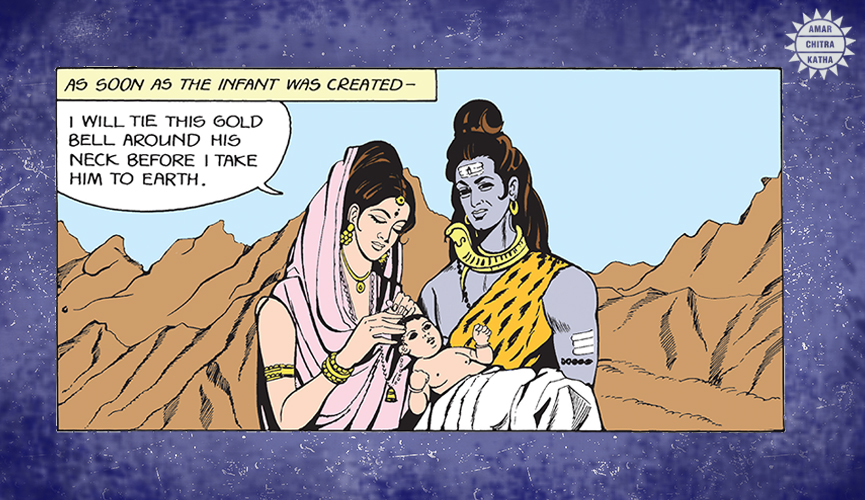
When he came to know of Brahma’s boon to Mahishi, Shiva realised that only a child born to him and Vishnu could put an end to the demoness. Shiva then approached Vishnu, who took the form of Mohini, the divine enchantress. Vishnu, as Mohini, gave birth to Shiva’s child – a boy who was fated to end Mahishi. 

Script: Shyamala Mahadevan; Illustration: M. Mohandas

The divine child was left in a forest with a golden bell tied to his neck. Soon, a king named Rajashekhara found him. Since the king had no heir of his own, he took the boy home and raised him as his own son. The boy was named Manikanthan, after the golden bell at his neck. As Manikanthan grew up, he showed wisdom and skill beyond his age. He also started performing miracles and healing the subjects of the kingdom. 

When Manikanthan was twelve years old, the queen gave birth to a son. Wanting to see her biological son ascend the throne, she plotted to have Manikanthan killed. Pretending to be gravely ill, she asked the boy to get a tigress’ milk as a cure. Though he was a young boy, Manikanthan was brave and dutiful. He willingly went to the nearby forest to fetch what the queen desired. 

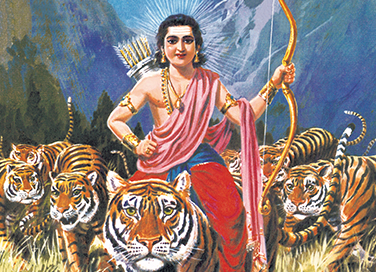
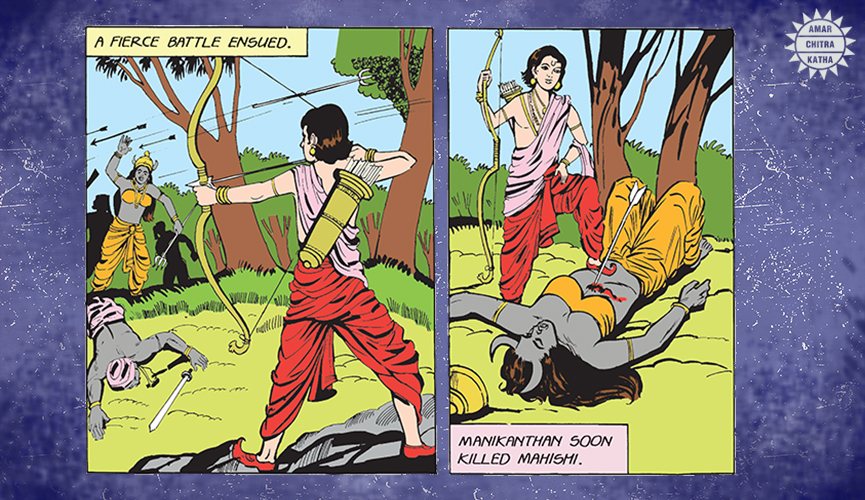
The forest that he had ventured in was the domain of Mahishi, the demoness. Upon seeing Manikanthan in her territory, she decided to slay him. A fierce battle ensued, and Manikanthan emerged victorious. As his divine purpose was fulfilled, Indra appeared before him and transformed into a tigress. Other devas too turned into tigresses and Manikanthan rode into the kingdom with a horde of tigresses. 

Script: Shyamala Mahadevan; Illustration: M. Mohandas

Soon, a divine voice announced the boy’s real identity to the king and his subjects. Manikanthan asked the king to forgive the queen for her evil plot and then left his earthly abode to inhabit his true form as a god. The king then built a grand temple dedicated to the divine child, who later came to be known as Ayyappan. 

Sanjeevani: The Magical Herb

By Srinidhi Murthy

Sanjeevani, also known as Vishalya Karani, was a magical herb that grew on the peaks of Mount Gandhamadana. This herb saved Rama’s brother, Lakshmana, during their battle with Ravana. Read the story of how Hanuman brought this herb in time to save Lakshmana’s life. 

Ravana’s attack

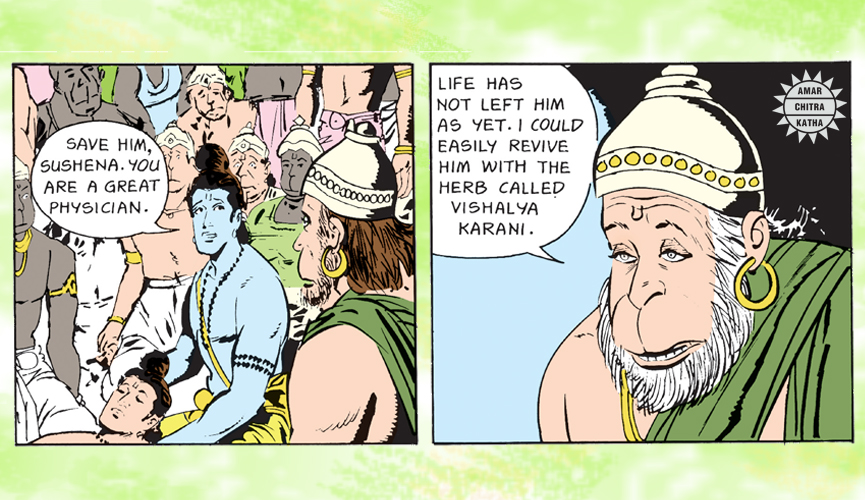
During the final battle between the army of Ravana, the king of Lanka, and Rama, the prince of Ayodhya, Ravana hurled a spear at Lakshmana. Rama came forward to save his brother as he fell and drove away Ravana. Unfortunately, Lakshmana fell unconscious as the spear had already struck him before Rama’s arrival. The injury brought Lakshmana to the brink of death. Distressed, Rama asked Sushena, the Vanara physician, to save his brother’s life. Sushena examined him and declared that Lakshmana could still be saved with the magical herb called Vishalya Karani, or Sanjeevani, that was available on Mount Gandhamadana. He further added that the herb would need to be fetched before sunrise. However, soon Sushena revealed that it would take eighteen years for them to reach Gandhamadana. It seemed as though getting the herb was an impossible task and Rama and the army had lost hope for Lakshmana’s life. 

Script: Luis M. Fernandes; Illustration: Ram Waeerkar
Hanuman to the rescue

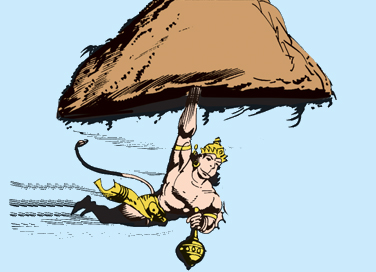
Suddenly, Hanuman stepped out of the crowd and promised to bring the herb before sunrise. Sushena instructed Hanuman to look for a golden creeper with blue flowers growing on either side of the river flowing down one of the peaks of Gandhamadana. After receiving Rama’s blessings, Hanuman increased his size and then, with one leap, rose high into the sky. As he flew, Ravana saw him from Lanka and immediately guessed that Hanuman was flying to get the magical herb. He was determined to stop Hanuman and ensure that Lakshmana could not be saved. 

The agreement 

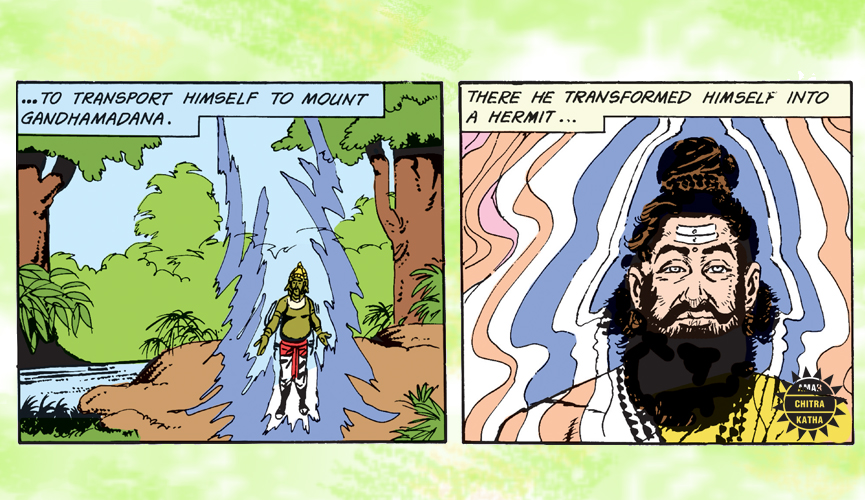
Ravana summoned Kalanemi to defeat Hanuman. Kalanemi was a fearful monster-magician with four heads, eight eyes and eight arms. Ravana promised half of his kingdom to the monster if he succeeded in defeating Hanuman. Kalanemi was terrified at the thought of a battle with Hanuman. He reminded Ravana about Hanuman’s powers and added that he would be dead if he tried to destroy the son of Vayu. However, Ravana ignored his words and asked him to drown Hanuman in the river in Gandhamadana, as the river was home to a ferocious crocodile. Left with no choice, Kalanemi agreed to the task and quickly transported himself to Gandhamadana. There, he transformed himself into a hermit and created a hermitage. He then waited for Hanuman’s arrival.

Script: Luis M. Fernandes; Illustration: Ram Waeerkar
Kalanemi’s trick

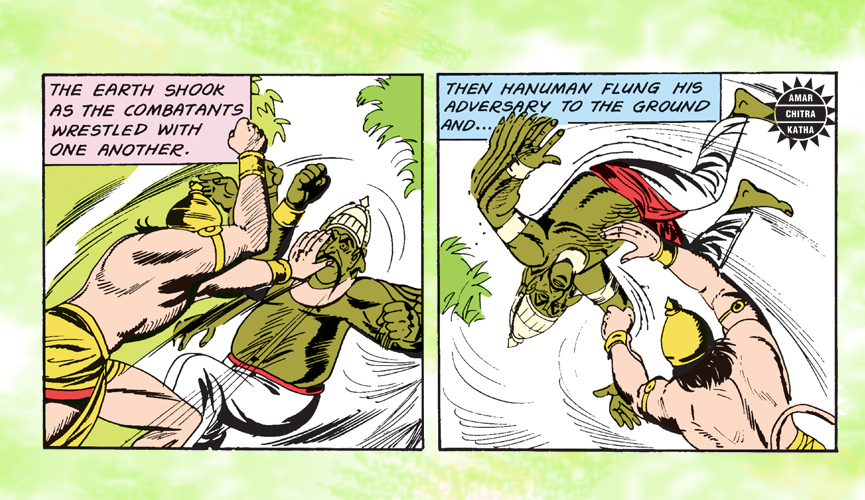
When Hanuman arrived, he immediately paid his respect to the disguised Kalanemi and mentioned the purpose of his visit. Kalanemi asked him to go and bathe in the river. He promised Hanuman that if he bathed in the river, he wouldn’t feel thirsty for a whole year. When Hanuman agreed, Kalanemi was delighted at the thought of claiming his reward from Ravana. Soon, Hanuman saw a  crocodile approaching him to attack. He quickly caught hold of the reptile and flung it to the shore. To his surprise, a celestial dancer emerged in front of him. She explained that she was cursed by Indra to become a crocodile and decreed to live in the river till she was liberated by Hanuman. The celestial dancer also revealed the real identity of Kalanemi to Hanuman and advised him to be careful. Hanuman confronted Kalanemi upon his return and soon a fight ensued between them. Hanuman threw the rakshasa in the sky and he landed dead in Ravana’s court.

Script: Luis M. Fernandes; Illustration: Ram Waeerkar
Another hurdle

Ravana was disappointed by Kalanemi’s death. However, he wasted no time in planning his next move. Since he was the master of three worlds, he summoned Surya, the sun god, and ordered him to hasten the hour of his rise. Sometime later, Hanuman saw a rosy glow on the horizon, while he was still searching for the herb. To save Lakshmana, Hanuman decided to get hold of Surya’s chariot. The charioteer of Surya was shocked when he saw that the huge vanara had caught hold of the chariot and begun to whirl it around. Surya asked Hanuman the reason for stopping him. Hanuman explained his emergency and requested him not to rise before Lakshmana was restored to health. Surya sympathized with him but told Hanuman that he could not help him as he was under the orders of Ravana. Quick-witted Hanuman immediately asked Surya to lean forward and to hear out a secret. But when he did, Hanuman quickly embraced him in a tight hug, got bigger in size and held him in his arms. He then rushed back to Gandhamadana to continue his search for the herb.

A glorious return

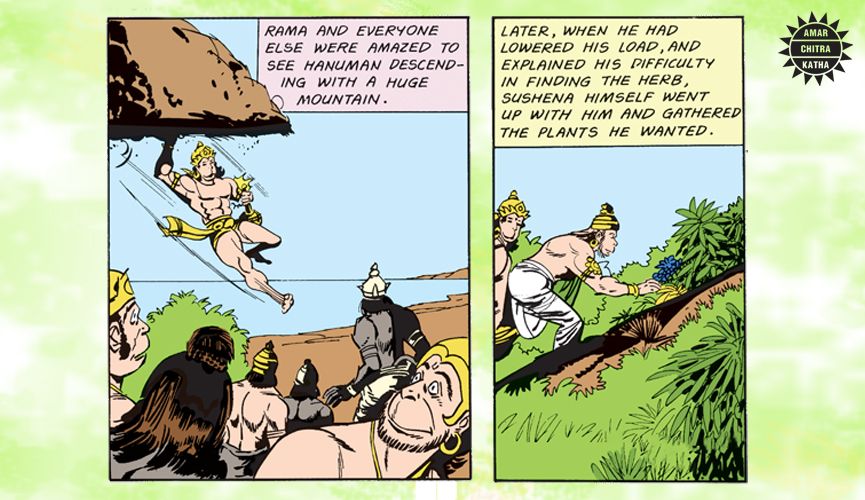
Despite his efforts, Hanuman was not able to find the golden creeper with blue flowers that Sushena had mentioned. While he was wondering about the whereabouts of the herb, he saw some Gandharvas singing and dancing. Hanuman approached them and asked them about the Sanjeevani herb. He told them about the battle between Rama and Ravana and how the herb was essential for the Lakshmana’s survival. However, the Gandharvas informed him that they had never heard of anyone named Rama. Then they crowded around Hanuman and began to tease and torment him. Hanuman struck back at his tormentors, but chaos broke out among the Gandharvas due to the unexpected fight. Witnessing the chaos, Hanuman decided to continue his search, and not waste time-fighting. Unfortunately, try as he might, Hanuman could not find the herb. In the end, to save time, he decided to lift the whole mountain and take it with him to the camp.

Script: Luis M. Fernandes; Illustration: Ram Waeerkar

After he reached,  Sushena himself went and gathered the plants he wanted from the mountain. He made a paste out of herbs and held it to Lakshamana’s nose. Soon, Lakshmana woke up from his unconscious state. After the completion of the mission, Hanuman restored the mountain to its original place and healed the wounded Gandharvas, with the same herb. When Hanuman returned, Rama asked him about the shining object under his arm. Hanuman told him the story of how he had imprisoned the sun in his arms. Upon Rama’s orders, he released Surya, sought his forgiveness and allowed him to rise again. Rama, Lakshmana and the entire army were grateful for Hanuman’s efforts in saving Lakshmana’s life. 

Read the complete Ramayana in our best-selling collection Valmiki’s Ramayana, now available on the ACK Comics App, Kindle, Amazon and with other major e-tailers. 
The Parijata Tree

By Srinidhi Murthy

The Parijata tree emerged as one of the divine valuables during Samudra Manthan (the churning of the ocean). The celestial tree bore beautiful white flowers and had a divine fragrance. This tree was placed in Indra’s heavenly abode. Read the story of how Indra and Krishna fought for its possession.

Aditi’s earrings
Script: ACK Editorial Team; Illustration: Ram Waeerkar

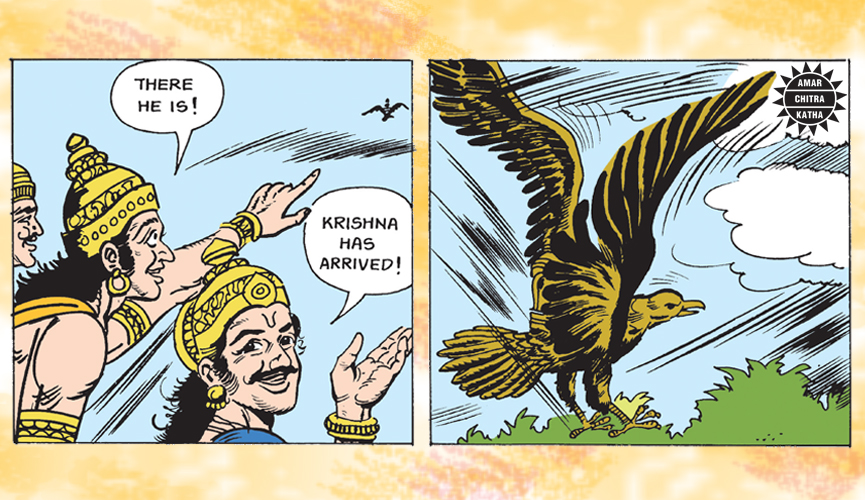
Narakasura was a vicious asura who took pleasure in terrorising the inhabitants of all three worlds. He invaded heaven and drove Indra out of his abode. The asura also snatched Aditi’s earrings during one of these attacks. Indra approached Krishna for his help in defeating the evil asura. Krishna, along with his wife Satyabhama, rode on Garuda to confront Narakasura in his capital Pragjyotisha. After a fierce battle, he finally defeated Narakasura, with Satyabhama at his side.

Satyabhama’s disappointment
Script: ACK Editorial Team; Illustration: Ram Waeerkar

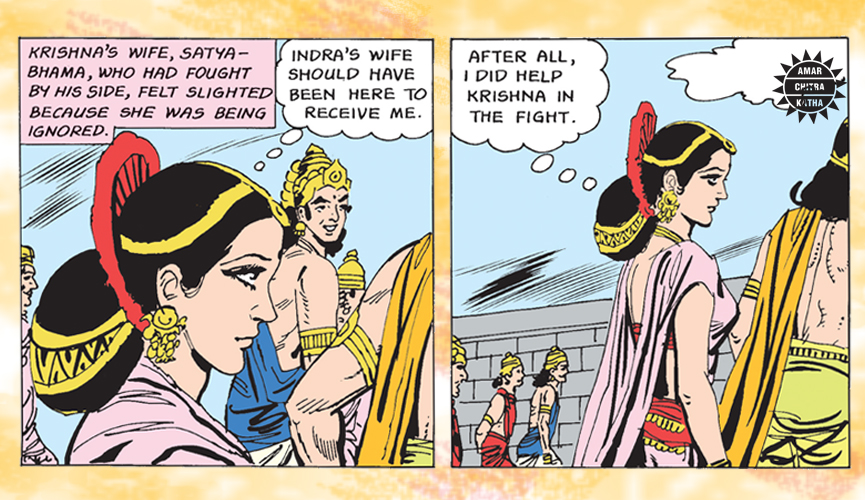
After killing Narakasura, Krishna and Satyabhama visited heaven to return Aditi’s earrings. Indra welcomed them and thanked Krishna for killing Narakasura for him. Satyabhama, who had fought the asura with Krishna, felt slighted as she was ignored by Indra. She was also affected by the fact that Indra’s wife Shachi, did not arrive with him to welcome her. When Shachi arrived to take the couple to Aditi, Satyabhama noticed that both Shachi and Aditi ignored her contribution to Narakasura’s defeat and gave their full attention to Krishna. Though disappointed, Satyabhama ignored the slight and prepared herself to return to Dwaraka with Krishna.

Visiting Nandana

Seated on Garuda, Krishna and Satyabhama started their journey to Dwaraka. On their way, they landed at Nandana, Indra’s garden, to spend some time there. Satyabhama was impressed with the divine Parijata tree and decided to take the tree to Dwaraka. Suddenly, one of the guards approached them and prohibited both Krishna and Satyabhama from taking the tree as it belonged to Shachi. He added that taking the Parijata tree would infuriate Indra. Satyabhama was angry. She announced that nothing could stop Krishna, the slayer of Narakasura, from taking the tree. Terrified, the guard ran to Shachi, to report to Satyabhama.

Fight for the Parijata tree

Angered by Satyabhama’s words, Shachi asked Indra to stop them.  Indra marched to Nandana with his army. When Krishna and Satyabhama noticed the arrival of Indra with his army, they realised that he meant to fight them for the Parijata tree. Soon, a fight ensued between Krishna and Indra’s army. Krishna cut down their arrows faster than they were shot. Even Yama and Indra himself were no match for Krishna. Meanwhile, Garuda attacked Indra’s mount Airavata. The run of the startled elephant caused chaos in the celestial army and the army began to flee. Indra himself was all set to flee, but Krishna asked him to stop.  

Happy ending
Script: ACK Editorial Team; Illustration: Ram Waeerkar

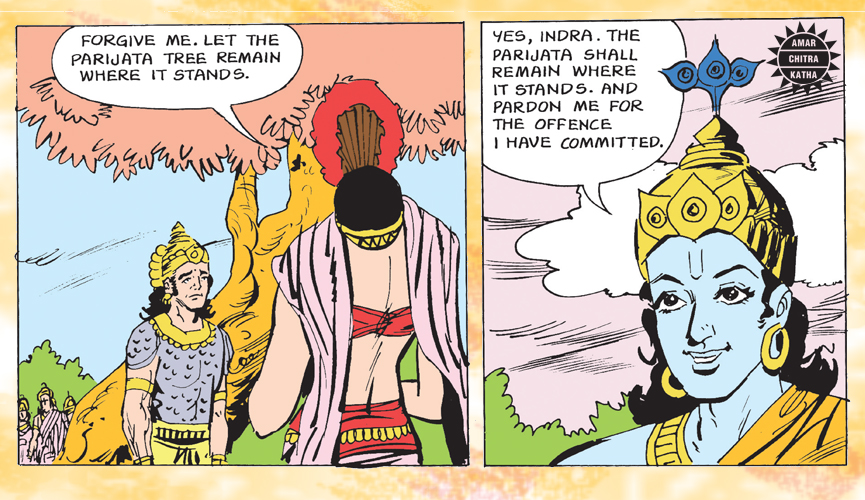
Satyabhama said that since Indra was the Lord of the Celestials, he should not suffer humiliation. She then added that she started this fight to teach a lesson to Shachi as she deliberately ignored her part in the battle with Narakasura. Both Satyabhama and Krishna apologised to Indra and asked him to let the tree remain where it stood. Indra also apologised to the couple for fighting. He requested them to take Parijata to Dwaraka, as a symbol of their forgiveness. Krishna and Satyabhama flew to Dwarka on Garuda, carrying the celestial tree with them.

Read the comic book of the Prajita Tree by Amar Chitra Katha on the ACK Comics App, Kindle, Amazon, and more.

Ashwatthama’s Gem

By Srinidhi Murthy

According to the Mahabharata, Dronacharya was the teacher who trained both, the Pandavas and the Kauravas, in the art of warfare. He was married to Kripi, the sister of warrior Kripacharya. They both had a son, who was named Ashwatthama. Ashwatthama was born with a precious gem on his head. This gem made the wearer invincible. It eradicated hunger, thirst, disease as well as fear of weapons, robbers, rakshasas, nagas and even gods.

The Kurukshetra War between the Pandavas and the Kauravas ended with the death of Duryodhana, a close friend of Ashwatthama. Furthermore, Ashwatthama also lost his father, as Drona was killed through deception during the war. Enraged and grief-stricken, Ashwatthama entered the Pandava camp on the last night of the war, with the sole purpose of taking revenge. He killed warriors like Dhrishtadyumna, Shikhandi, Drupada and the five sons of Draupadi, while they were resting in their camp. Filled with rage and grief, Draupadi asked the Pandavas to bring her the precious jewel on Ashwatthama’s head to avenge the death of her sons.

Arjuna and Ashwatthama engaged in a terrible fight where they released Brahmashira, a powerful weapon, to destroy each other. The weapon had the potential to cause large-scale destruction and so, Vyasa and Narada intervened in their fight and asked both of them to withdraw their weapons. Both agreed to the wishes of the sages. Having obtained these weapons after severe austerities, Arjuna had the ability to withdraw his powerful celestial weapon. However, Ashwatthama could not do so, though he tried his best. Ashwatthama’s weapon was directed to destroy the future progeny of Pandavas. When he could not call back the weapon, he appealed to Vyasa for help. Vyasa then asked Ashwatthama to give the Pandavas his precious gem to compensate for his wicked act. However, Krishna intervened and declared that despite Ashwatthama’s weapon, the Pandava dynasty would continue through the unborn son of Abhimanyu and Uttara. 

Script: Margie Sastry; Illustration: Dilip Kadam

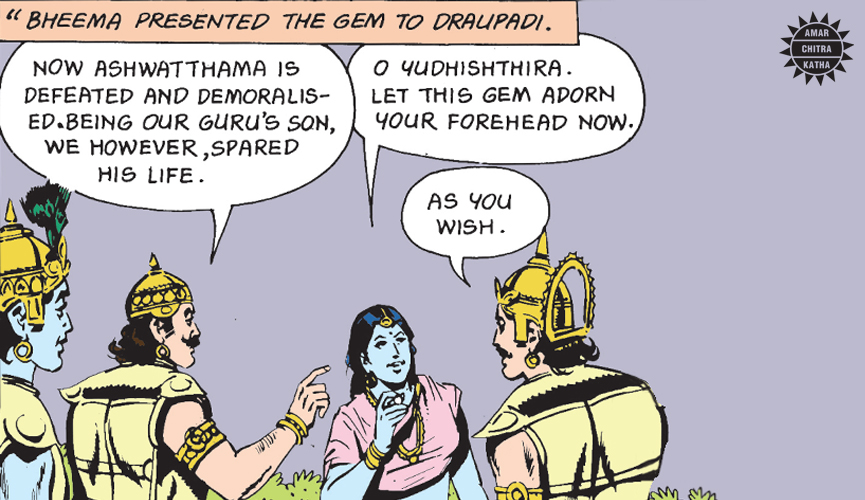
The crisis averted and the Pandavas returned to Draupadi with the precious gem. Ashwatthama retreated into the forest, filled with remorse. After being presented with the gem, Draupadi gifted it to Yudhishthira.

The Syamantaka Jewel

By Srinidhi Murthy

Syamantaka was a precious jewel that had the power to bring prosperity and end famine and war. However, its disappearance created trouble for Krishna himself. Here is the story of how Krishna found it and eventually cleared his name. 

A gift from the Sun god 
Script: Kamala Chandrakant; Illustration: H.S. Chavan

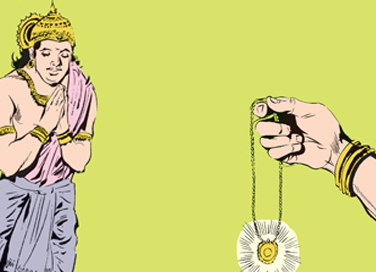
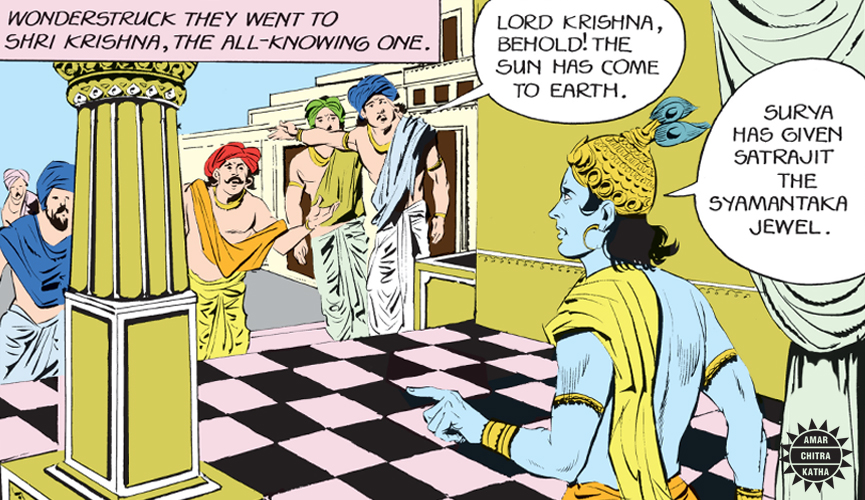
Prince Satrajit of Dwaraka was a devotee of Surya, the Sun God. One day, pleased with his devotion, Surya presented him with the Syamantaka jewel. When Satrajit rode back to Dwaraka, the people noticed that their prince was shining with a strange light. Wonderstruck, they all went to Krishna, who explained to them that it was due to the power of Syamantaka. He further added that the jewel had the power to end famine and war. In a few days, Satrajit noticed that the jewel also gave him eight measures of gold each morning. He installed Syamantaka in a temple and worshipped it daily.

Krishna’s visit

One day, Krishna visited Satrajit, who welcomed him warmly. Krishna praised the devotion of Satrajit, due to which he acquired such a precious jewel. Then, Krishna told Satrajit that since he had obtained enough gold, he should give the jewel to King Ugrasena as the jewel would be safer with a king. Satrajit immediately rejected Krishna’s suggestion and refused to part with the jewel. 

Syamantaka in Jambavan’s hands
Script: Kamala Chandrakant; Illustration: H.S. Chavan

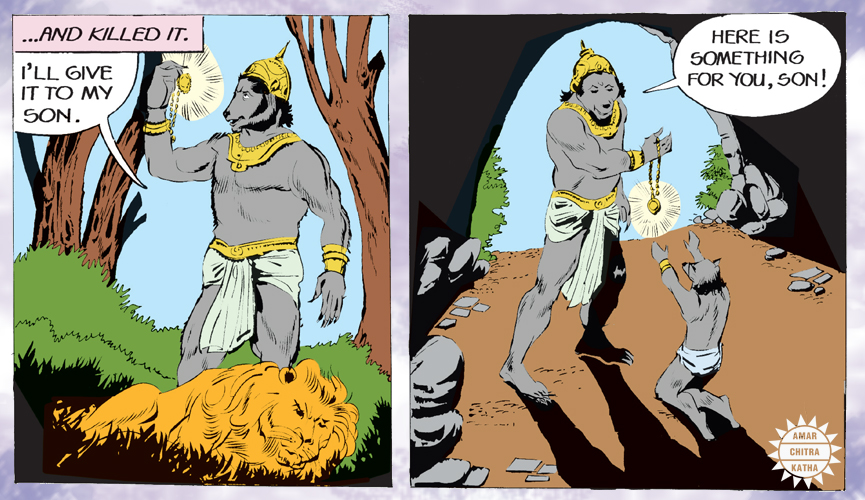
A few days after this incident, Prasena, the brother of Satrajit, went on a hunt, wearing the Syamantaka. Unfortunately, he was killed by a lion and the lion took the jewel from Prasena. As the lion walked with the jewel, Jambavan, the king of bears, saw him. Jambavan saw the precious jewel and decided to present it to his son. He attacked the lion, killed it, and then presented the jewel to his dear son. 

Satrajit’s suspicion 

Meanwhile, at Dwaraka, Prasena’s absence created suspicion in Satrajit’s mind. He suspected that Krishna killed his brother to acquire the jewel. When Krishna learned about Satrajit’s suspicion, he became determined to clear his name. He immediately went to the forest with his men, to trace the location of Prasena. Krishna and his men soon found the dead body of Prasena and also noticed the lion’s marks on his body. The men then followed the footsteps of the lion and found it lying dead in front of a cave. Krishna asked his men to wait for him, as he went inside the cave all alone.

Krishna and Jambavan 
Script: Kamala Chandrakant; Illustration: H.S. Chavan

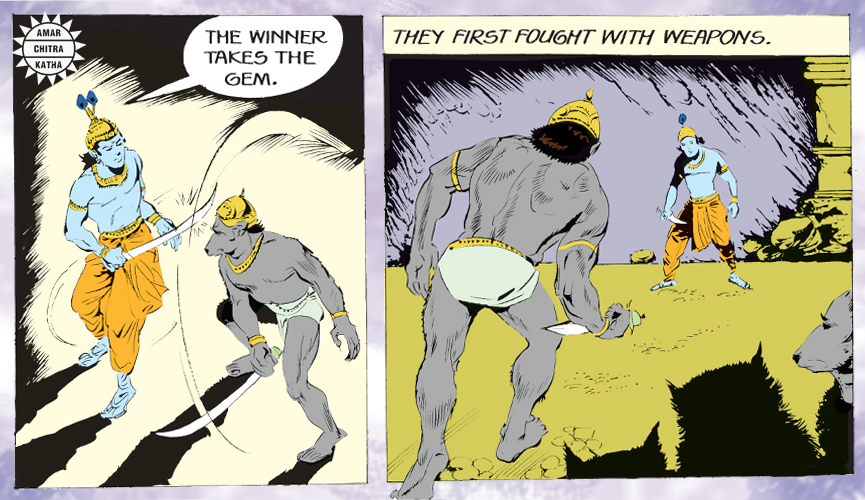
Krishna noticed that the jewel was in the hands of a small bear, who was Jambavan’s son. Though Krishna tried to take back the jewel without scaring the child, Jambavan’s son noticed him and cried loudly. Hearing the cries, Jambavan emerged to fight the stranger who had frightened his son. Krishna agreed to fight with a condition that the winner would take possession of the jewel. Soon, a fierce fight ensued between Krishna and Jambavan. Meanwhile, outside the cave, the men waited patiently for the return of Krishna, for the next twelve days. When Krishna did not return, they assumed he was dead and returned to Dwarka to convey the sad news to his parents and wife. 

Return of the Jewel

Inside the cave, Krishna and Jambavan fought for twenty-eight days. They fought with weapons, boulders and even uprooted trees. Jambavan, realizing the strength of Krishna, gave up the fight and surrendered himself to Krishna. Jambavan not only returned the jewel but also gave his daughter Jambavati in marriage to Krishna. As soon as they garlanded each other, Jambavati turned into a beautiful woman. Krishna returned to Dwaraka with the jewel and Jambavati. He returned the jewel to Satrajit, who apologized for doubting Krishna earlier. To make amends, Satrajit requested Krishna to accept his daughter Satyabhama as his wife. Krishan accepted his proposal and also asked Satrajit to give him yields of the gold.  Having proved his innocence, Krishna married Satyabhama in a joyous ceremony.

A new challenge
Script: Kamala Chandrakant; Illustration: H.S. Chavan

However, the disappointed suitors of Satyabhama – Akrura, Kritavarma, and Shatadhanwa – nursed thoughts of revenge on Satrajit. Shatadhanwa killed Satrajit without anyone’s knowledge and took possession of Syamantaka. In order to save himself from the wrath of Krishna, he approached Kritavarma and Akrura for help. When they refused to give him protection, he gave the jewel to Akrura and fled from Dwaraka. However, Krishna caught him and killed him when he tried to escape. A few days later, Akrura came to meet Krishna to give him the jewel. Krishna refused the jewel but asked Akura to declare that he had its possession, to clear the doubts from the minds of Dwaraka’s citizens. Having cleared all doubts and suspicions about his innocence, Krishna returned to his home to spend time with his family.

Read more stories of Krishna in our title Bhagavat, now available on the ACK Comics App, Kindle, Flipkart, Amazon, and other major e-tailers.