


Christmas Through India’s Historic Churches

By Keya Gupta

Christmas in India is a mix of vibrant lights, carols, and family gatherings that light up late winter nights. It blends global faith with local cultures and warmth. Going beyond carols and Santa Claus, it wraps around our streets with processions, community feasts, and midnight masses that draw in people from every corner, turning faith into a warm, shared feeling of joy and peace, no matter where you are. From the misty hills to coastal towns, churches light up as the real heartbeat of it all, each one carrying stories that make the season feel so unique. 

Malankara Church, Kerala 

In Kerala, the Malankara Church is shaped by ancient St Thomas Christian traditions. It traces its history back to 52 A.D., when St Thomas is believed to have landed on the Malabar coast, linking the shores of Kerala to ancient Syria. One of the most striking traditions is a procession followed by the Christmas bonfire, known as ‘Thee-Jwala Shushrusha’, held outside the church. The streets are filled with colour as processions with figurines of baby Jesus and nativity scenes pass by. It is believed that baby Jesus must be brought inside from the cold to keep him warm, and the ceremonial fire is lit and blessed as the congregation and choir gathers to sing hymns and carols in ancient Aramaic, Malayalam and English.  

The Syro-Malabar Christians also follow a period of fasting or austerity in the 25 days leading up to Christmas, similar to the observance of Lent before Easter. These celebrations show how customs from around the world have been adapted to local cultures.   

Velankanni Church, Tamil Nadu 

Also known as the Basilica of Our Lady of Good Health, due to the healing properties believed to be dispensed by Mother Mary here, Velankanni Church in Tamil Nadu is a blend of cultural expression, similar to St Thomas Church in Palayur. The church features soaring white gothic towers, blended with Indian styles of architecture that give it a look unlike any other church. The statue of Mother Mary housed here is adorned in a shimmering saree and gold jewellery rather than usual depictions of her in a tunic and cloak. Pilgrims flock here year-round, but Christmas amps up the fervour. The congregation comes together with hymns and local folk tunes. 

Velankanni shrine Art: Srinath Malolan M
Basilica of Bom Jesus, Goa 

More than 400 years old, the Basilica of Bom Jesus in Goa is a UNESCO world heritage site. It houses the preserved body of St Francis Xavier, who was said to have miraculous healing powers. The basilica has ornate gilded interiors and an imposing exterior, which is lit up for Christmas. It is a time when children enact the nativity, and the congregation gathers in hushed silence to witness the miracle of Christ’s birth.  

St Paul’s Cathedral, Kolkata 

Built in 1847, St Paul’s cathedral is a unique fusion of architectural styles, featuring not only Indo-gothic elements but also Islamic domes and Victorian era features, a blend of local masonry and British blueprints. Having been built in the British colonial era, it is a true confluence of cultures. The cathedral and its massive stained-glass windows are decorated and lit up to reflect the holiday cheer. Churchgoers throng to midnight mass, as choirs sing ethereal carols, hymns, and songs. Not just the church, but the entire area reflects the festive mood of the season.  

St. Paul’s Church. Art: Srinath Malolan M

This season transforms cities and villages alike, with decorations popping up in markets and streets across India. Families exchange gifts, share hearty meals and head to church for services that mix English hymns with local tunes. It is a time when churches become the heart of the festivities, each one weaving its own thread into the country’s colourful tapestry. 

Read stories on Mythology, History and Folklore on our very own ACK Comics App

Christmas in India: What’s cooking around the country?

by Nidhi Murthi 

December is here, and so is Christmas, our favourite winter day of the year. Food and stories are the important ingredients that connect us in a celebration. Let us explore how different Indian regions celebrate Christmas with their unique festive foods. 

Bebinca 

According to legend, a Portuguese nun named ‘Sister Bebiana’ from Santa Monica Convent, Old Goa, used the excess of leftover egg yolks to create a seven-layered cake. Each layer represented the seven hills of Old Goa and Lisbon, the capital of Portugal. Taking the priests’ suggestion, Bebiana added a dozen layers to her cake instead of seven. The dessert came to be known as ‘Bebinca’, named after her. Today, Bebinca is a multi-layered cake, made with up to 16 layers. As making this cake requires a lot of patience, many Goan families reserve Bebinca for special celebrations, such as weddings and Christmas.  

Art: Abhirami Ganesh
Gajrela or Carrot Pudding 

Around the 16th-century, in Mughal India, Gajar ka Halwa (Carrot Pudding) was made as a rich, milk-and-ghee-based winter dish. It was created to celebrate the harvest of vibrant red winter carrots, which are available in North India during the month of December. Known as Gajrela in Punjab, grated carrots are slow cooked in sugar, milk, cardamom, and heaps of ghee, with khoya, or mawa, a kind of soft cheese, folded in for texture at the end. Gajrela is now enjoyed as a warm, aromatic food during the cold Christmas in Punjab, making it a favourite across the region.  

Plum Cake 

In 1880, a trader from Thalassery in Kerala, Mambally Bapu, returned home after he learnt the art of making biscuits in Burma. In 1883, during Christmas time, a British planter named Murdoch Brown brought a British Plum cake with him and asked Bapu to replicate it. Bapu accepted the challenge and baked a plum cake, but added arrack, a local brew made from cashews, apples, and Kadalipazham, a type of banana, to the batter. Brown tasted Bapu’s cake and loved the dish. Since then, plum cakes have become deeply associated with Christmas celebrations in Kerala and are widely enjoyed by the local community. 

Smoked Pork Curry  

In Nagaland, smoked pork holds deep cultural importance and is especially significant during Christmas. The traditional practice of smoking meat began as a way to preserve pork during the cold winter months. Over time, it became a cherished culinary tradition passed down through generations. Today, smoked pork curry is an essential part of Christmas celebrations, symbolising warmth, togetherness, and sharing food with family and community. It is commonly eaten with steamed rice and enjoyed alongside tea or locally brewed drinks. 

Art: Tithee Dixit
Roast Duck 

Did you know that ‘Boro Din’ (Big Day) is a popular Bengali name for Christmas in Kolkata? During British colonial rule, many Anglo-Indian communities were formed in West Bengal. They followed British traditions, including roasting poultry for Christmas. Ducks were used as they were more readily available in the Bengal wetlands than turkeys. Over time, most people added their own touch by including spices like cinnamon, ginger, and red chilli powder to the roast duck and paired it with fragrant yellow rice (pulao) or roasted vegetables, passing the recipe down through generations. So, Roast Duck has an important place in the community’s Christmas feasts in Kolkata, even today. 

This year let’s enjoy the flavours of Christmas along with the stories attached to it. In the end, that’s what makes the moment truly special. 

Read stories of Mythology, History and Folklore at or very own ACK Comics App.

Winter Solstice: The Longest Night

by Keya Gupta

This time of the year, the days are short and the night falls sooner. Winter Solstice reminds us that while it is cooler and darker right now, warmer and lighter days are ahead. Winter Solstice is the longest night of the year. It has the latest sunrise of the year and earliest sunset, after which the sun starts to slowly rise earlier and set later, bit by bit. It usually falls on the 20th or 21st of December, falling on the 21st this year.  

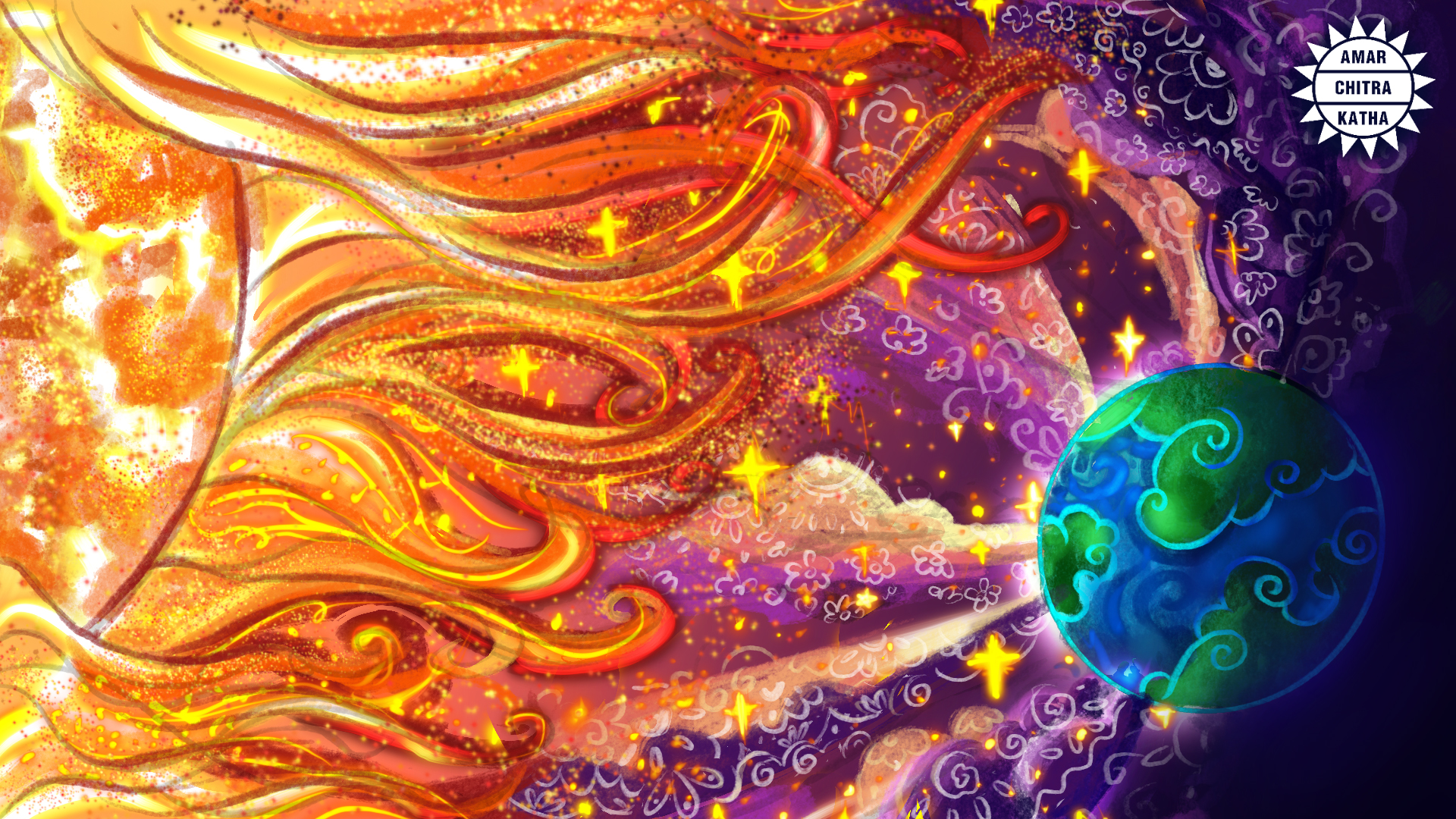
Despite what you might think, this is caused not by how far away we are from the sun, but due to the tilt of the Earth’s axis! The Earth does not orbit upright, and its axis is tilted by 23.5 degrees, causing the Northern and Southern Hemispheres to switch places in receiving the sun’s light directly. In the Northern Hemisphere, as we tilt away from the Sun, we experience winter, which causes the nights to grow longer too. In the Southern Hemisphere, as the Earth leans towards the sun now, the seasons are flipped, and 21st December is Summer Solstice there. Winter Solstice in the Southern Hemisphere falls around 21st June, which is the Summer Solstice in the Northern Hemisphere! 

Art: Saumya Ray

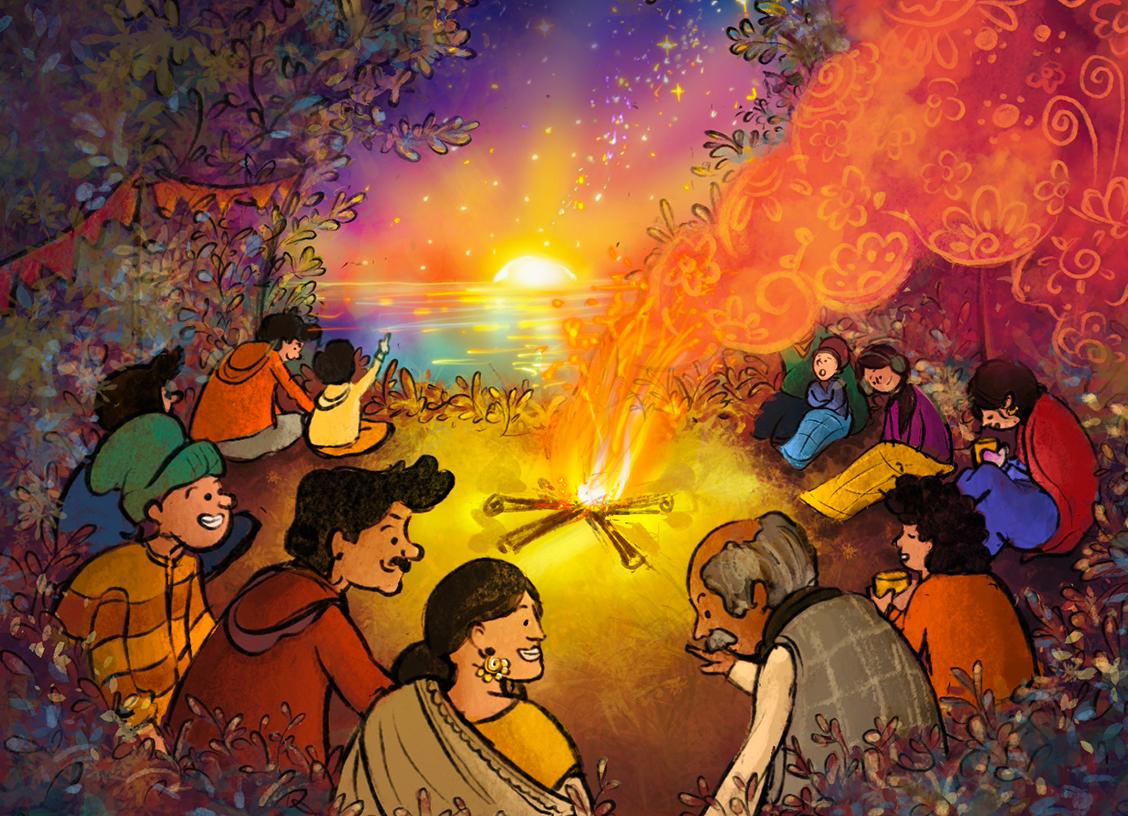
In Indian astrology, Winter Solstice is the point at which the sun ends its southward movement (dakshinayan) and begins its movement north (uttarayan). While we know that the Sun does not move, rather, the Earth moves around it, if you observe the sunrise and the movement of the sun every day, you will slowly watch it move northward. This is traditionally a time of renewal and celebration, and many cultures all over the world celebrate festivals around this time. As the days grow longer henceforth, the Solstice represents the triumph of light over darkness and is often associated with themes of rebirth, renewal, and hope.  

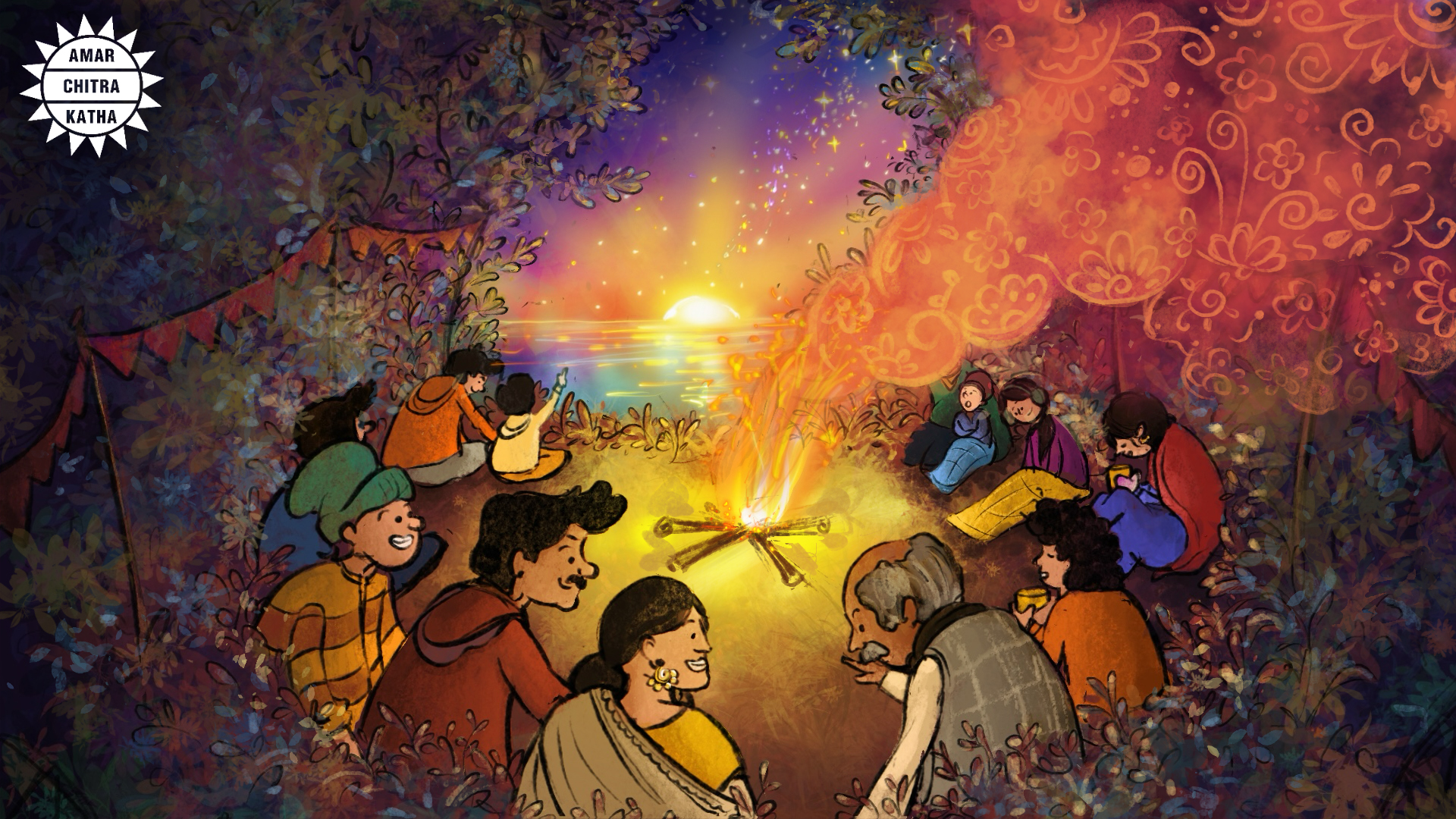
In many parts of India, the Winter Solstice finds its echo in the celebrations of Lohri, Makar Sankranti, and Pongal, which together signal the end of the year and the beginning of a gentle sun. While Winter Solstice itself falls around 21st December, these festivals arrive a few weeks later. Lohri, celebrated in northern India, especially Punjab, is both a harvest festival and a way of welcoming the lengthening of days after the Solstice. It is traditionally believed to mark the longest night of the year, even though it falls in mid-January, reminding us that cultural calendars sometimes follow the rhythm of agriculture and community memory more than strict astronomical timing. Around the same time, Makar Sankranti and Pongal mark the harvest in other parts of India and celebrate the Sun’s northward journey, Uttarayan. While each region has its own customs; kite-flying in Gujarat and parts of North India, sweet til-gud in Maharashtra, and freshly harvested rice in Pongal offerings in Tamil Nadu, there is a shared sense of standing at a turning point and leaving behind the long, dark nights.  

Art: Saumya Ray

Indian myths also recognise the importance of Winter Solstice. In the MahabharataBheeshma was granted the boon of choosing the moment of his death. After being defeated, he lay on a bed of arrows for 58 days, waiting until Makar Sankranti, when the Sun began its northward journey or Uttarayan before finally giving up his body, believing that passing away during Uttarayan can lead to liberation, or moksha. Another story linked to Makar Sankranti tells of Surya, the Sun God, and his son Shani, or Saturn, the Lord of the sign Capricorn. Their relationship is strained in many tellings of the myth, but this is the time of year when Surya visits Shani in his own sign, and that visit becomes a symbol of reconciliation, forgiveness, and mending of family bonds. Just as the Sun appears to move northward and days slowly lengthen, these tales suggest that relationships, too, can move from cold distance towards warmth and understanding. 

Winter Solstice may bring the longest night, but it is also the point from which the days slowly begin to grow, almost too gradually to notice at first. As the sun lingers a little longer each day, this time of year becomes a reminder that change often begins in small, steady steps, and that light has already started to return long before we can fully see it. 

Read stories on Mythology, History and Folklore at our very own ACKComics App.

Theyyam: When Gods walk among us

by Shree Sauparnika V

In the sacred groves and village shrines of North Kerala and neighbouring parts of Karnataka, a centuries-old tradition continues to bind communities together. This tradition is Theyyam — a ritual where devotion, memory, and art come together in honour of local deities and ancestral spirits. Theyyam, derived from the Malayalam word Deivam, means God or Incarnation of God. For families who have nurtured this ritual for generations, Theyyam is a living connection between people, land, and the divine. 

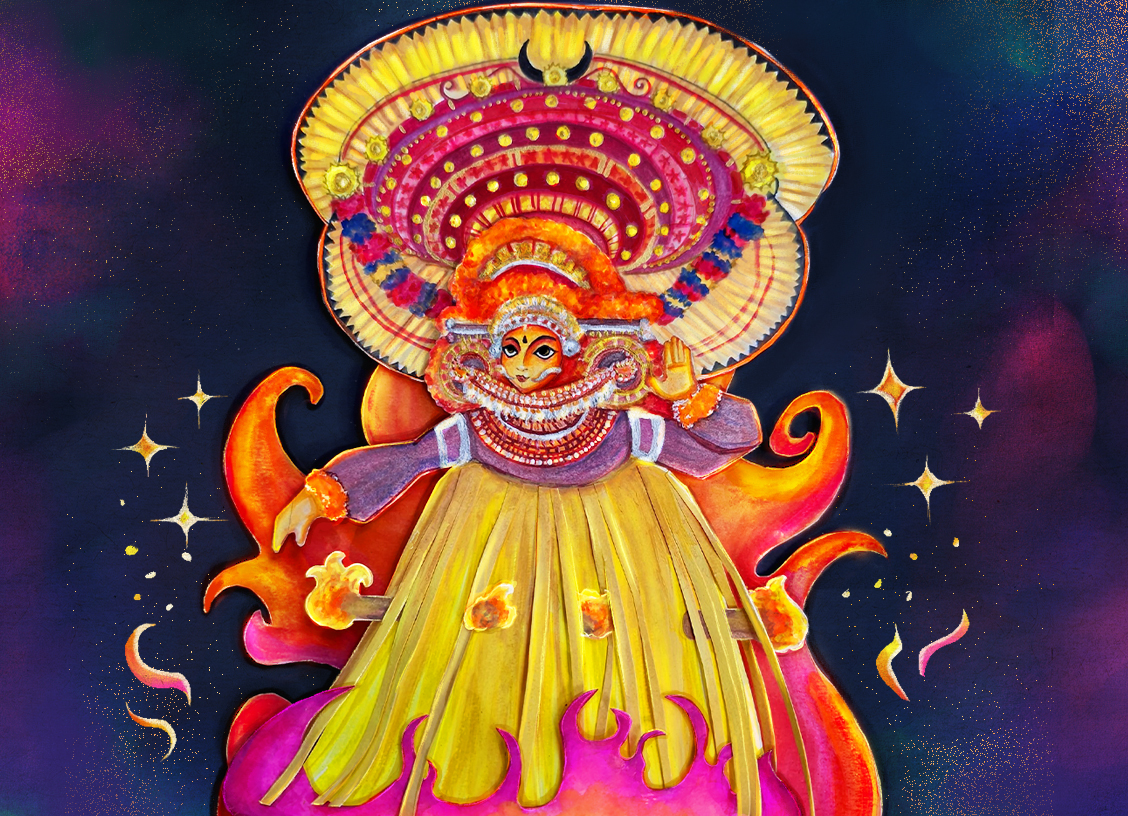
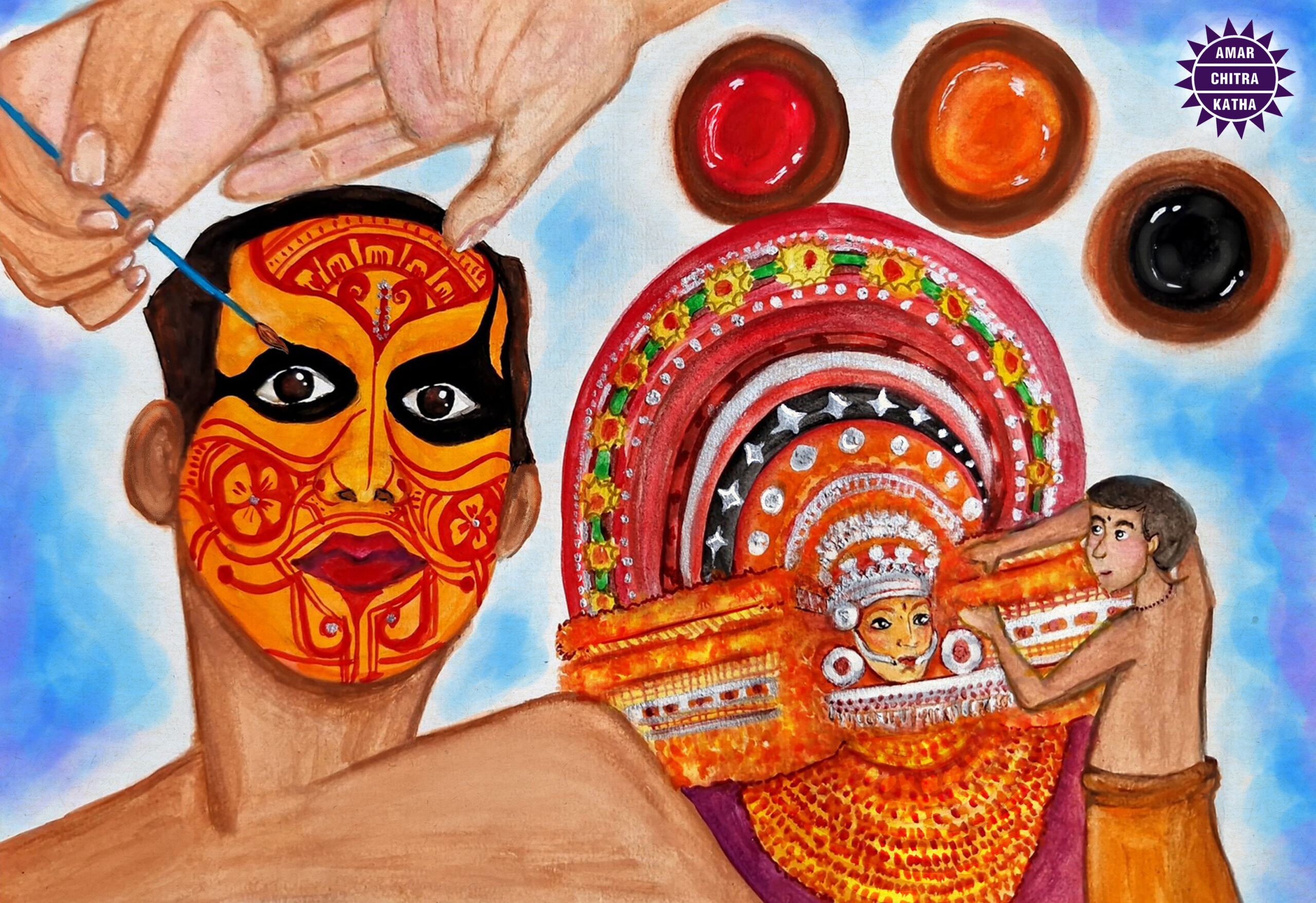
Theyyam is an art form that combines dance, theatre, mime and worship. Theyyam performances typically take place in open   courtyards or small temples called kavusThe devotees stand around or even perch on the nearby sacred trees. A performance can last anywhere from 12 to 24 hours, depending on the importance of the deity. The chief dancer, who represents the central deity, observes strict rituals— abstinence, fasting, prayer and solitary meditation— and, after sunset, does not eat till the performance is over. His elaborate makeup is done by trained specialists. The face painting itself is an art form. Patterns like vairadelamkattaramkozhipuspam, etc. are drawn using bright primary and secondary colours. The bold contrasts help create the stylised expression that defines Theyyam. Only natural materials are used to make traditional dyes: rice paste for white, and turmeric for yellow. The dominant colour used is red, signifying action, energy, and anger, which is achieved with a mixture of turmeric and limestone. Black is produced by burning rice paddy husks and mixing the ash with coconut oil. 

Art: Abhirami Ganesh

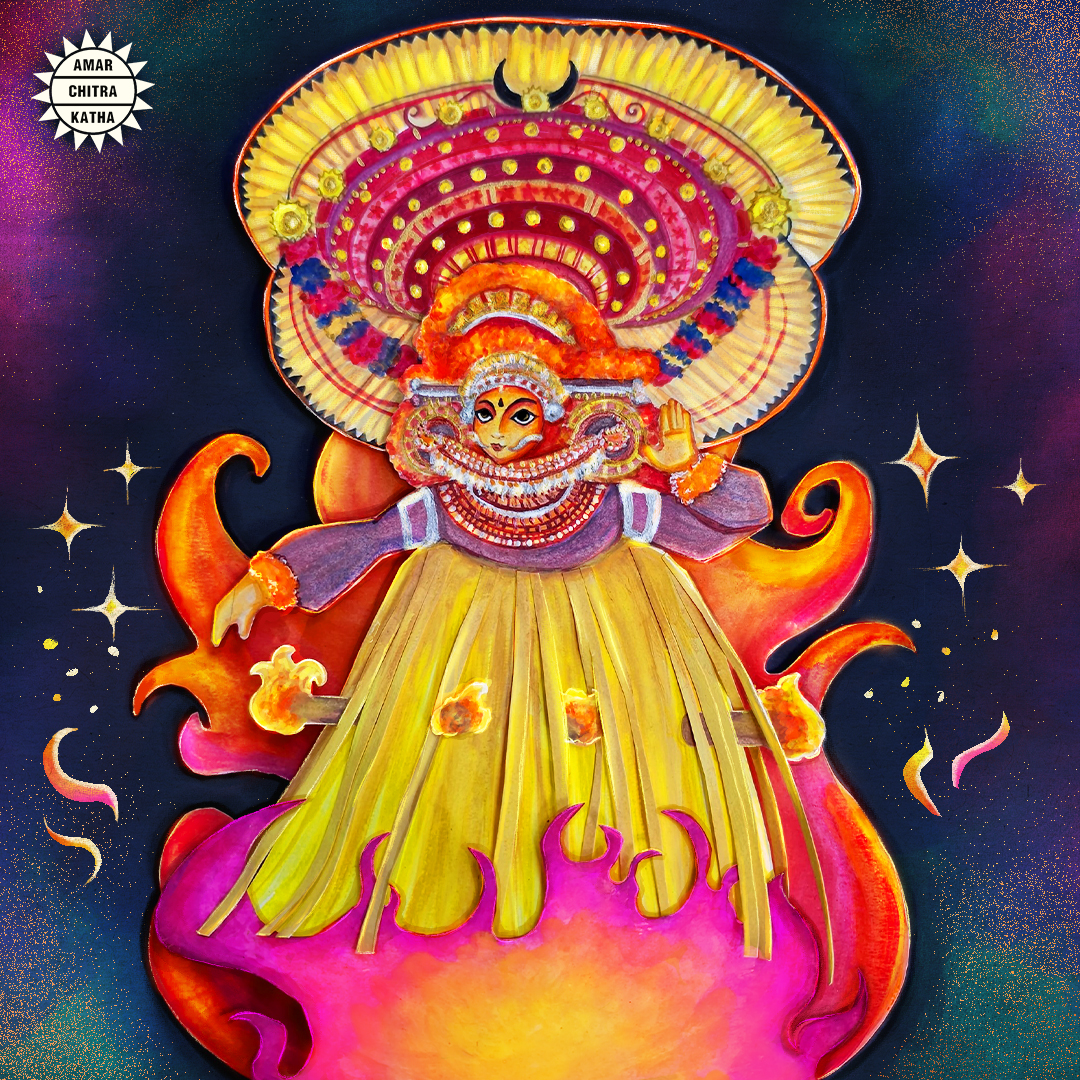
The performance begins with Vellattam or Thottam, a simpler ritual segment where the dancer appears without full makeup or costume, wearing a small red headdress as he recites the deity’s story. Before the main performance, the dancer begins with a ritual song, joined by the drummers. This song describes the myths and legends of the deity or folk hero being honoured. It is accompanied by the steady rhythm of traditional instruments. After this first invocation, the dancer returns to the green room. A short while later, he reappears — this time with full makeup and costume. 

Once ready, the dancer steps before the shrine and begins his slow ‘metamorphosis’ into the deity. This moment is deeply symbolic — it marks a shift in status, a crossing of boundaries, where an ordinary human becomes a divine presence. After observing a few more rituals, he places a towering headdress on his head, takes up a shield and sword, and begins to dance. In the background, instruments like the chendatudikuzhal, and veekni build the rhythm. The dance moves through a series of structured steps called Kalaasams, each repeated in order. What unfolds is a powerful blend of music, movement, chanting, and dazzling costumes. 

Theyyam season is usually from October to May. The best time to experience a theyyam performance would be in November and December. 

There are more than 400 theyyams documented, each with its own legend: 

  • Hero Theyyam: Honours local heroes and martyrs who sacrificed their lives for the community (e.g., Pottan, Kathivanoor Veeran). 
  • Ancestral Theyyam: Invokes revered ancestors or clan spirits for guidance and family harmony (e.g., Gulikan, Kandakarnan). 
  • Animal/Bird Theyyam: Celebrates the bond between humans and nature by embodying animals or birds from myth and folklore (e.g., Pulikali, Pakshi). 
  • Spirit Theyyam: Drives away harmful spirits or supernatural forces, often rooted in local legends (e.g., Karinthandan, Thondachan). 
  • Protective Theyyam: Offers protection for health, prosperity, crops, and entire villages from misfortune or evil (e.g., Muchilottu Bhagavathi, Padikutti Amma) 
Art: Abhirami Ganesh 

Theyyam is mainly performed by males, except for the Devakkoothu theyyam (at Thekkumbad Koolom Bhagavathi Temple in Kannur) which is performed by women. The story of Devakkoothu involves six goddesses coming to pluck flowers, with one getting lost and eventually rescued by Narada, a narrative best suited for a female embodiment. Only non-menstruating women, after a strict 41-day penance (Vrata), are chosen from specific families to perform this role, often older women past menopause, emphasising purity and sacred duty. 

For those gathered, the experience of Theyyam is unforgettable. Children fall silent, elders close their eyes, and everyone feels the same rush — something powerful, something larger than life. Some moments toward the end of a performance leave a deep, lasting impression: a dancer, fully entranced, running face-first into burning embers; an animal sacrifice that marks an ancient offering; or a deity speaking through the performer, giving guidance to devotees they have never met. You leave stunned, overwhelmed, and almost entranced yourself — exactly how one might feel if we truly believed that gods walk among us. 

Read more stories on Mythology, History and Folklore at our very own ACK Comics App.
 

More Than Play: Childhood Games

by Keya Gupta 

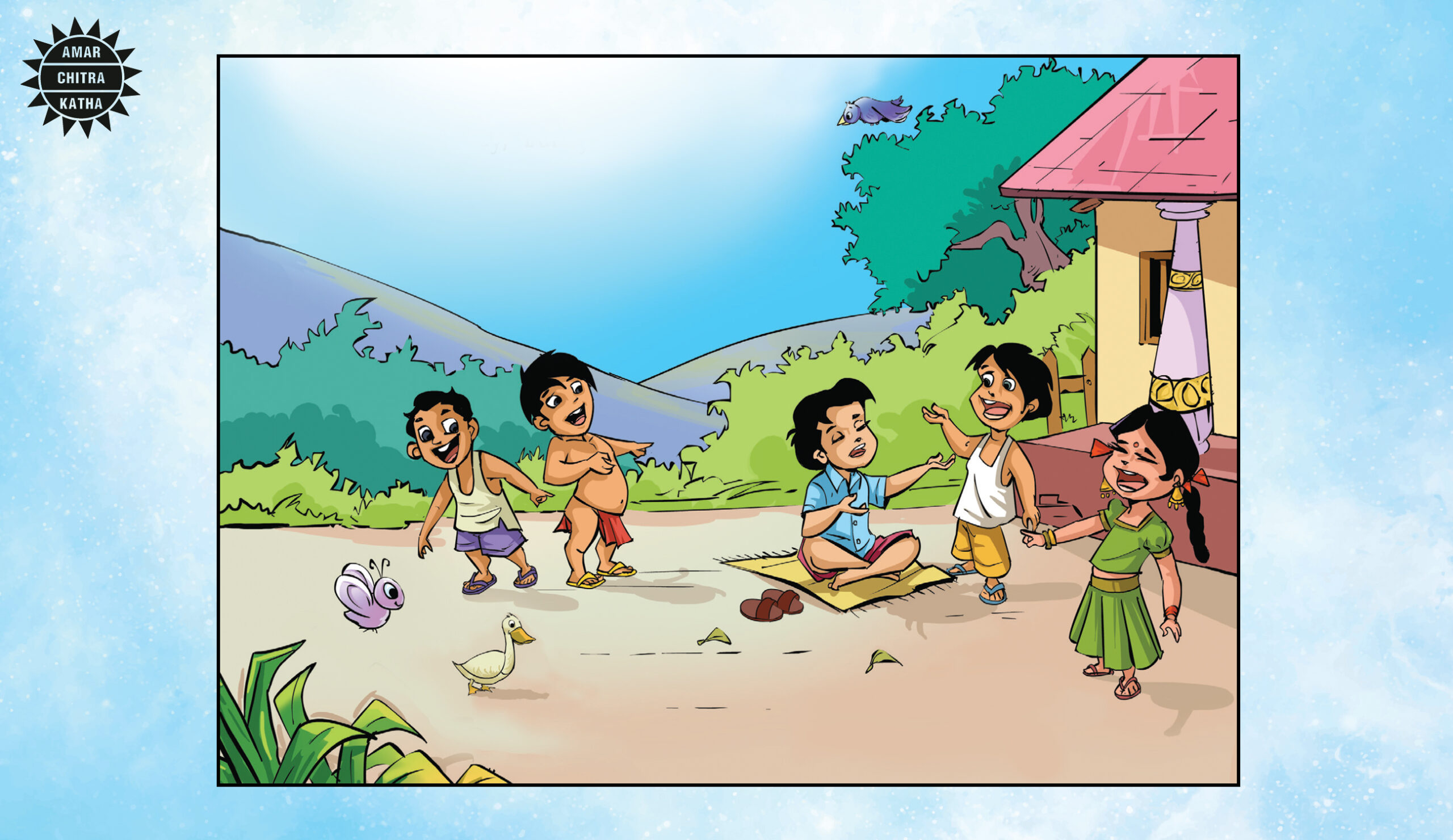
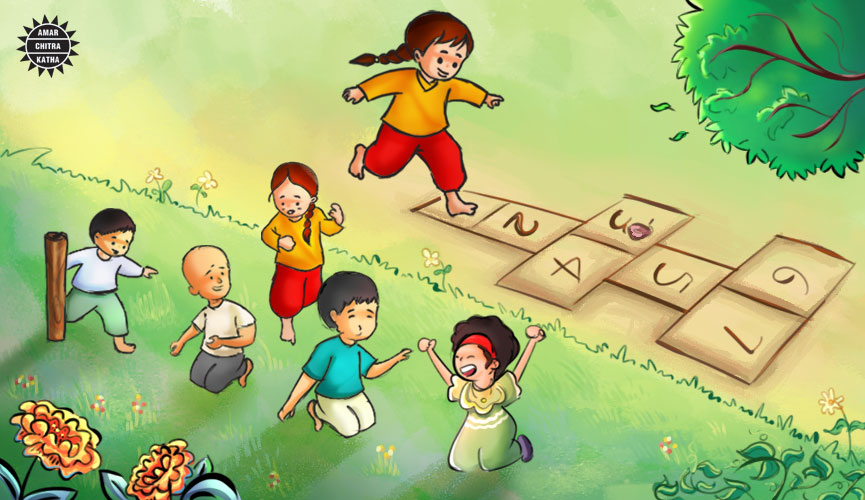
Our childhoods are shaped by noisy school classrooms, neighbourhood parks, playing with friends, and lots of games. These games filled out days and afternoons, or any free moment we could get. Regardless of when you grew up, childhoods were always full of the simple joy of playing, waiting for your turn, and laughing together. Along the way, these games taught us much more than just play and song. If we look beyond the fun moments, we see that they connect us to our roots, passing down culture from one generation to the next. They offer lessons in balance, agility, and teamwork that stay with us long after we have left the playground. No surprise then, that despite the world constantly changing, certain traditional games have stuck around. 

Art: Srinath Malolan M. and Harshal N.
Hopscotch 

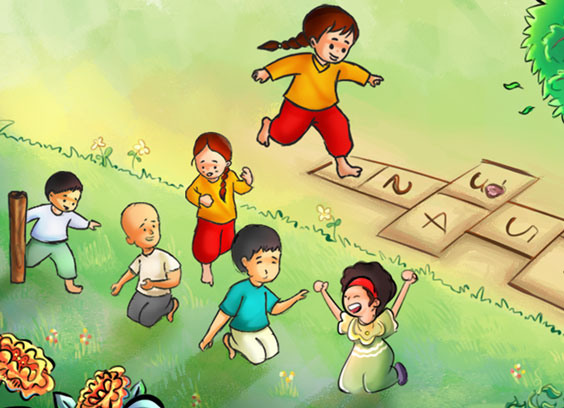
You just need a small piece of chalk to begin playing Hopscotch. The exact origin of hopscotch is debated, though variants trace back thousands of years. Children draw a set of numbered boxes on the ground and hop through the squares on one foot, picking up a small stone or marble while avoiding breaking the pattern or stepping on the edges. The game usually starts with tossing a stone into the first box. Every child remembers the challenge of balancing and the thrill of getting through all the boxes. Hopscotch helps develop balance and coordination, but it is also as much about focus as it is about movement. 

Kho-Kho 

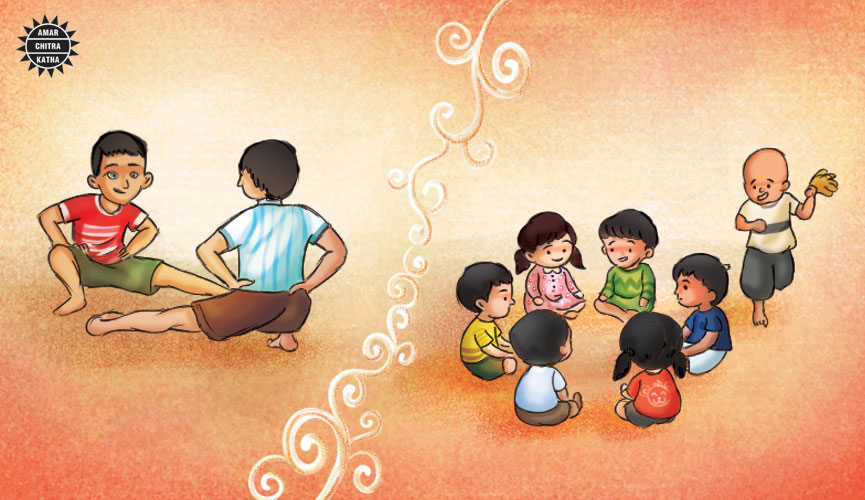
This classic chasing game is popular across India and is said to have originated in Maharashtra, in the form we now know it in. In ancient times, a version of the game, called ‘Rathera’, was played on chariots. In Kho-Kho, two teams compete, where one team chases while the other tries to avoid being touched. Players from the chasing team sit or kneel in a line, and one active chaser runs around trying to tag runners from the opposing team. The chaser can switch places with teammates by tapping them and saying “Kho”. Chasers must use speed, agility, and teamwork to catch opponents.  

Many even believe that the game originated from the Mahabharata. On the thirteenth day of the war, Dronacharya created the ‘Chakravyuh’ formation, a military defensive circle. Arjuna’s son, Abhimanyu, was the only warrior who dared to go inside and heavily injured the Kaurava warriors. However, fighting seven to one, Abhimanyu was eventually overpowered and lost his life. The method Abhimanyu used to fight this defensive circle is frequently used in Kho-Kho. 

The modern form of Kho-Kho was formalised in 1914 in the Gymkhana of Pune, which was founded by Lokmanya Tilak. Since then, Kho-Kho has been played across the nation and has even found an international stage in places such as the South Asian Games. 

Art: Srinath Malolan M. and Harshal N
Se Se Seboti 

In the green hills of Manipur, children have their own folk classics. Se Se Seboti is one such game which blends rhythm, movement, and song. The game has its own unique song which goes: 

Se se seboti Boboti son of Laishram,  

Let us have a duel  

To see who defeats who  

Like a Kouna (reed) I can uproot you  

Like a Thambou (stalk of lotus)  

I can break you 

Children gather and sing the song while challenging each other to various feats, such as arm wrestling, hopping or other challenges inspired by the song. The game is rooted in the stories and traditions of the Meitei community, with references to traditional elements and local flora (thambou), embedding elements of Manipuri everyday life. Martial arts is a key feature of Meitei culture and Se Se Seboti’s competitive spirit honours the region’s heroic past and warrior heritage.  

Kola Kolaya Mundhirika  

Down in the south, in Tamil Nadu, ‘Kola Kolaya Mundhirika’ is a popular game, where one person walks around a group seated in a circle, while singing a rhyme and holding a handkerchief. At any moment, the child can drop the handkerchief behind someone, who must chase and tag the child who dropped the handkerchief. Simple and energetic, it requires only a handkerchief and can be played anywhere at any time.  

One Game, Many Names 

An interesting thing about a lot of these games is that the same game is found with regional variants in different states and communities, being known by different names. For example, Hopscotch is called “Stapu” in North India, “Kith Kith” or “Ekka Dukka” in other Hindi regions, and “Paandi” in Tamil Nadu, with each region having different patterns and singing different rhymes. Tamil Nadu’s Kola Kolaya Mundhirika is not only played across India, but also across the world and called ‘Drop the Handkerchief’. This shows how games travel, adapt, and become part of local cultures all over the country. 

The language, location and community might change, but the spirit of these games remains the same. These traditional games are more than just a way to pass time; they connect children across the country and bring people together. 

Read more about Indian culture and history only on the ACK Comics app!

Drums, Dance, and Devotion — Harvest Festivals of Meghalaya

By Shree Sauparnika V

In the mist-covered hills of Meghalaya, two vibrant festivals bring communities together in joyful thanksgiving during the first few weeks of November — Wangala of the Garo people and Nongkrem of the Khasi tribe. Both celebrations honour the harvest, the land, and the spirits of nature — yet each has its own distinctive rituals, music, and meaning. 

Wangala – The Hundred Drums of the Garos 

Wangala is the major post-harvest festival of the Garo tribe, also known as the ‘Hundred Drums’ festival. It is dedicated to the sun-god Misi Saljong (also called Pattigipa Ra’rongipa), who is believed to bless a rich harvest. Typically celebrated between September and December, the festival marks the end of the agricultural year and the onset of winter. 

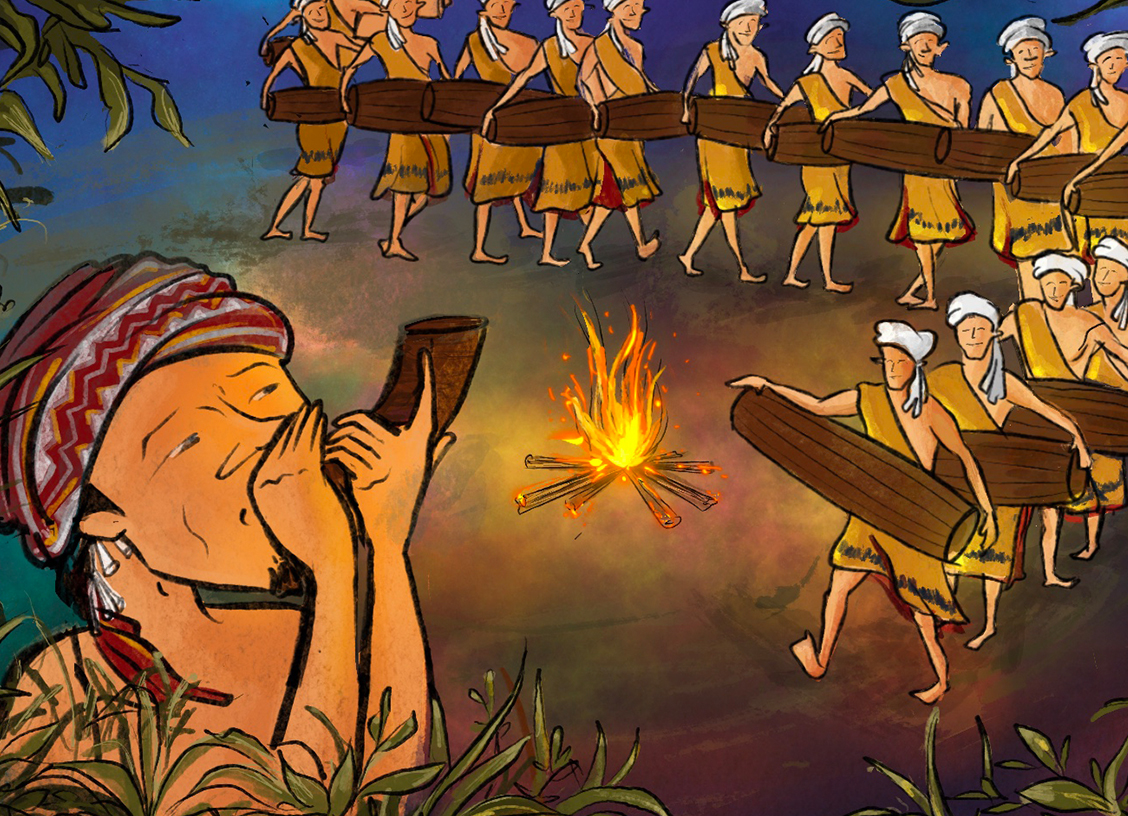
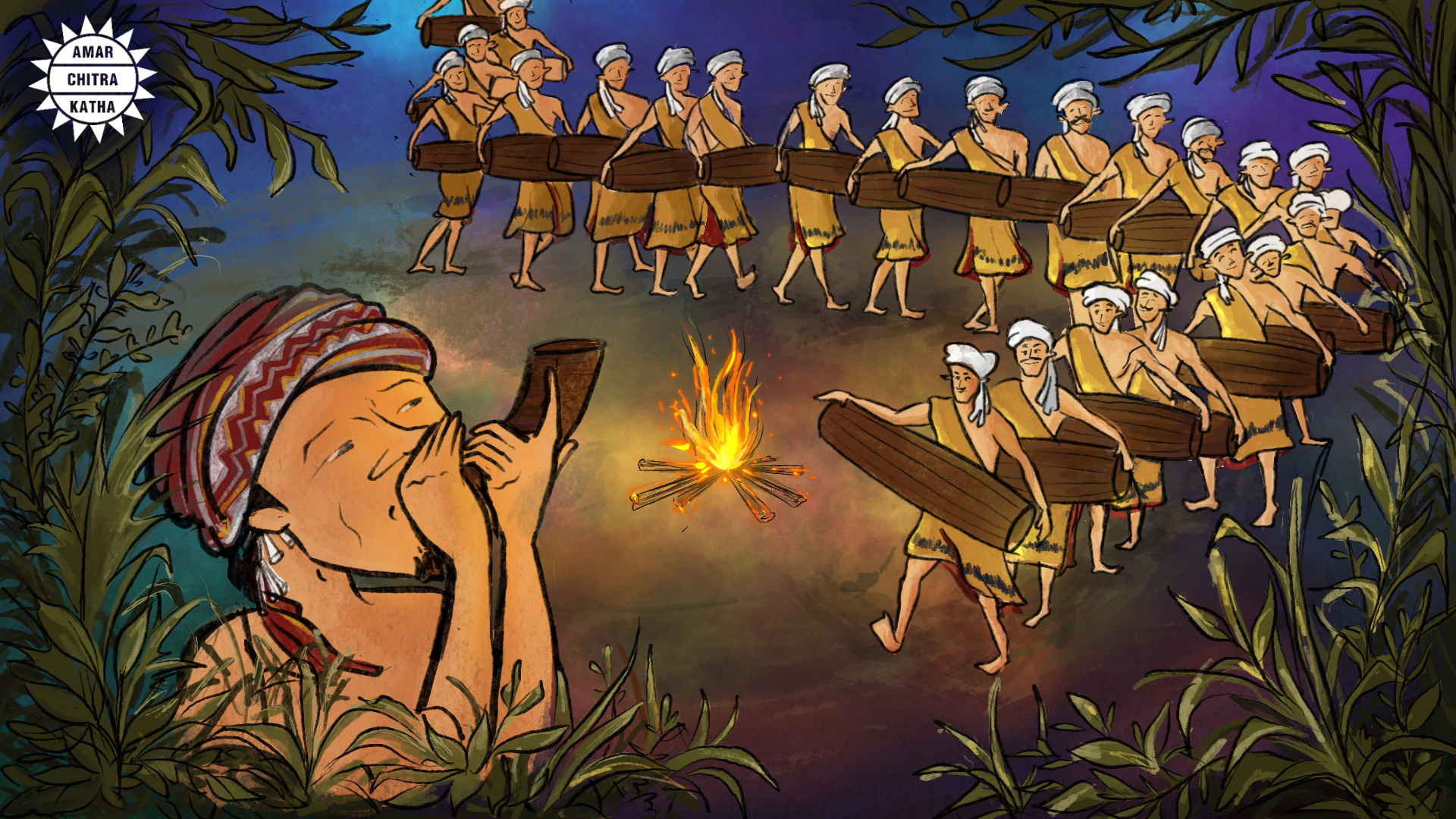
The celebration begins with the ritual Rugala, performed inside the village chief’s house, where offerings such as cooked rice, vegetables, and rice beer are made. On the following day, known as Kakkat, the public festivities begin with energetic drumming and dance. Men beat long, oval-shaped drums, women form parallel lines in colourful traditional attire, and flute-like instruments play alongside gongs and horns. 

Art: Saumya Ray

One of the most striking features of Wangala is how young and old come together in celebration — children, adults, and elders all join in the drumming, dancing, and community rituals. Through rhythm and movement, the Garos express gratitude, community identity, and the unity of nature and human labour. 

Nongkrem – A Sacred Dance of Thanksgiving 

Nongkrem (often written as Pomblang Nongkrem) is one of the most important festivals of the Khasi tribe. It is held at Smit, the cultural centre of the Khyrim Hima (indigenous kingdom) near Shillong, in November. 

The festival spans several days and involves sacred ceremonies led by the Syiem (traditional Khasi chief) and the high priestess. The key ritual is the Pomblang sacrifice (usually of a goat) offered to the deity Lei Shyllong — the guardian spirit of Shillong Peak — and to the ancestors of the ruling clan. 

Art: Saumya Ray

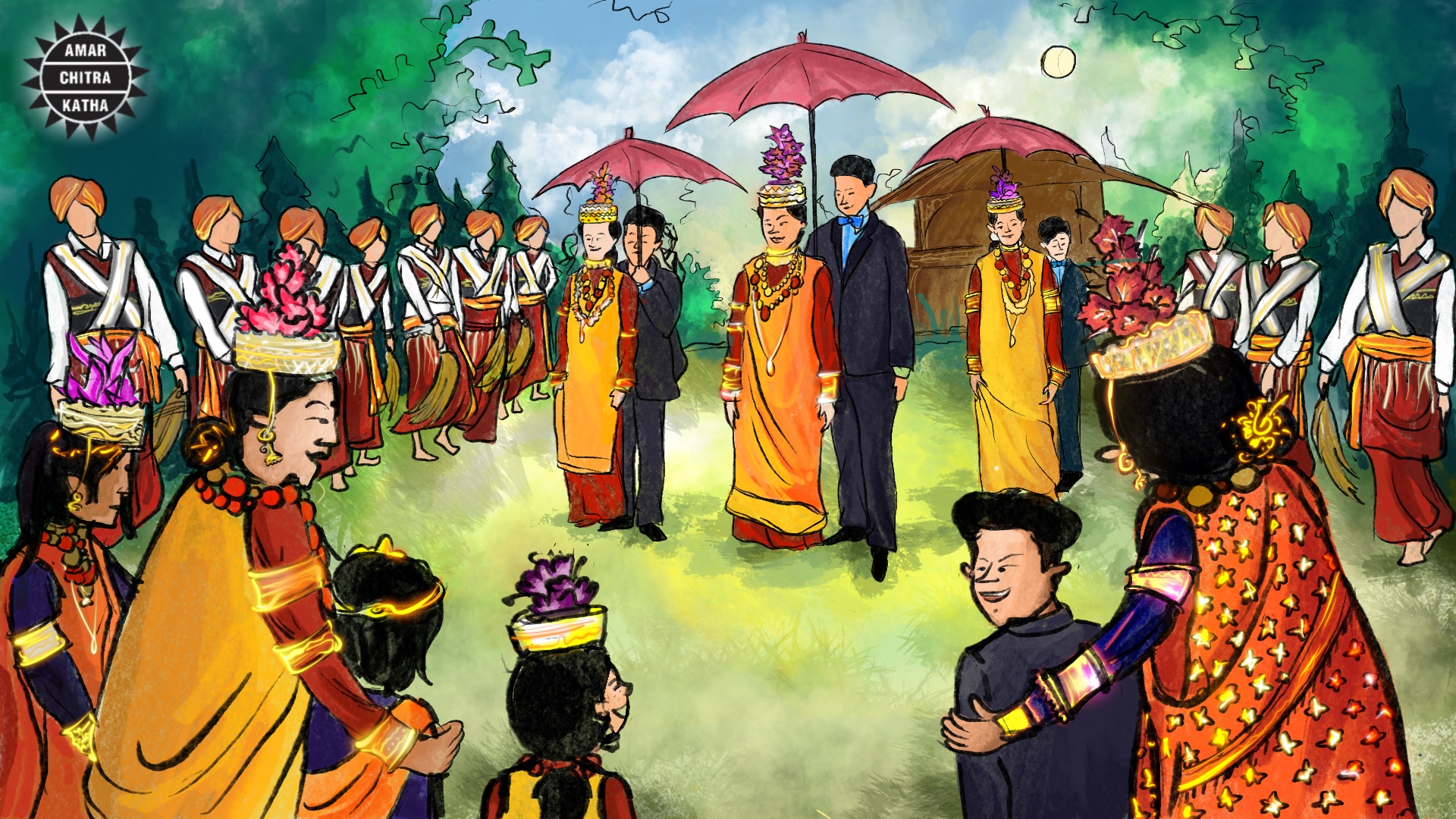
Once the rituals conclude, the rhythmic Nongkrem dance begins. Young Khasi women dressed in brilliant silk and wearing gold ornaments move gracefully to the beat of drums, while men holding swords and yak-hair whisks step up the rhythm with vigorous steps. The music of the tangmuri (a traditional pipe instrument) fills the air as the community expresses joy, unity, and gratitude. 

Nongkrem, thus blends devotion, heritage, and celebration — reinforcing the cultural identity of the Khasi people and their deep connection with the land. 

One Spirit, Many Songs 

Though Wangala and Nongkrem are celebrated by two different tribes, both festivals share a common heartbeat — one of gratitude, togetherness, and reverence for nature. Each dance step, drumbeat, and ritual reflects the people’s enduring bond with their environment and their ancestors.  

Find more stories on Tribal Myths and Legends at our very own ACK Comics App

Children Speak: A Children’s Day Special

by Keya Gupta and Shree Sauparnika V

Every year on November 14, India celebrates Children’s Day to honour the joy and imagination that children bring into the world. Did you know that Children’s Day, or Bal Diwas used to be celebrated on 20th November until 1964? After the death of India’s first Prime Minister, Pandit Jawaharlal Nehru, his birth anniversary was chosen as the date for Children’s Day, due to his fondness for children.   

This Children’s Day, we turned to the greatest storytellers of all — children themselves. (Please scroll past the banner to read more)


Art: M. Subramanian

We asked them to imagine, dream and share their thoughts about heroes, worlds and stories that inspire them. Here’s a compilation of a few of our favourite responses:

1.If you could switch places with a character from Indian mythology or history, who would it be? 

I think I would like to be Arjuna, the true disciple of Shri Krishna. His moment of doubt and awakening in the Bhagavad Gita teaches the power of courage, clarity, and duty. I connect with how he learns to listen within, understand life’s purpose, and act with both strength and compassion. 

Ishaan, 14, Delhi  

Savitribai Phule Saanvi, 10, Pune;   

Swami VivekanadaHrishikesh, 12, Mumbai 

AhalyaCara, 12, Dubai;  

Chhatrapati Shivaji MaharajManassvi, 7, Mumbai;  

Saraswati Riddhi, 9, Ernakulum;  

2.  If you could have an animal as your best friend, which animal would you pick and why? 

Elephant, because elephants are bold, strong, brave, and they never forget. 

Hrishikesh, 12, Mumbai 

Unicorn, because I would like to ride it and its horn has healing powers. 

– Manassvi, 7, Mumbai 

I would definitely choose a Galapagos Tortoise because then, my companion will last my lifetime (the average age of Galapagos is 177 years). I also would not need to run around much when I am old since the tortoise is slow. And maybe I can also learn how to enjoy a slow peaceful life from my companion. 

– Reyansh, 9, Jalandhar 

Scooby Doo, because he’s a funny talking dog and loves to eat. 

– Cara, 12, Dubai 

3. If you were to create a fantasy world, what 3 things would there be in it?  

Angry apples, houses built on clouds, and ants the size of houses and lots more. 

– Nikhil, 8, Bengaluru 

Inter-terrestrial aeroplanes, mobile phones to talk to aliens, and a magical coat to become invisible. 

-Yash, 10, Bengaluru 

Animals speaking human language., mountains and forest making imaginary straight roads for smooth traffic, humans flying. 

-Tarrinni, 11, Gurgaon 

Art: Dilip Kadam
4. If your life was a book, what would you title it?  

‘Nikhil the Boss’ 

Nikhil, 8, Bengaluru 

‘The Girl Who Kept Going’ 

Cara, 12, Dubai 

‘My Young Age Atrocities’ 

Ananya, 11, Trichy 

5. If you could make a comic about anything, what would it be 

The comic would be titled ‘Keepers of the Green Flame’. In a world where nature is fading, a group of children and magical creatures rise to protect the Green Flame, the spirit of the planet. It glows only when kindness and care for nature thrive. The story shows that every act of love towards Earth keeps its flame alive. 

– Ishaan, 14, Delhi 

A fantasy world full of surprises. 

– Saanvi, 10, Pune 

I would make a comic about the polar express coming to life and saving Christmas from corporate companies. 

Hrishikesh, 12, Mumbai 

Art: Dilip Kadam
6. How would you best like to celebrate Children’s Day?  

I will celebrate with orphans and homeless children so that they can feel special on the day. 

Saanvi, 10, Pune 

Have a ‘Yes Day’ where adults have to say yes to everything children ask for. 

– Nikhil, 8, Bengaluru 

I would want everyone to think and approach people like a child and give gifts to all children. It should be celebrated with family. 

Izabel, 12, Dubai 

The whole day I would have fun, eating and lazing around. 

Riddhi, 9, Ernakulam 


Thank you to all the children who shared their thoughts and dreams with us. Your ideas remind us that every story begins with imagination – and that the future of storytelling is bright in your hands. Happy Children’s Day! 

Check out our ACK Comics App for stories on Indian Mythology and History.

The Artisans of Diwali and Dussehra

by Keya Gupta

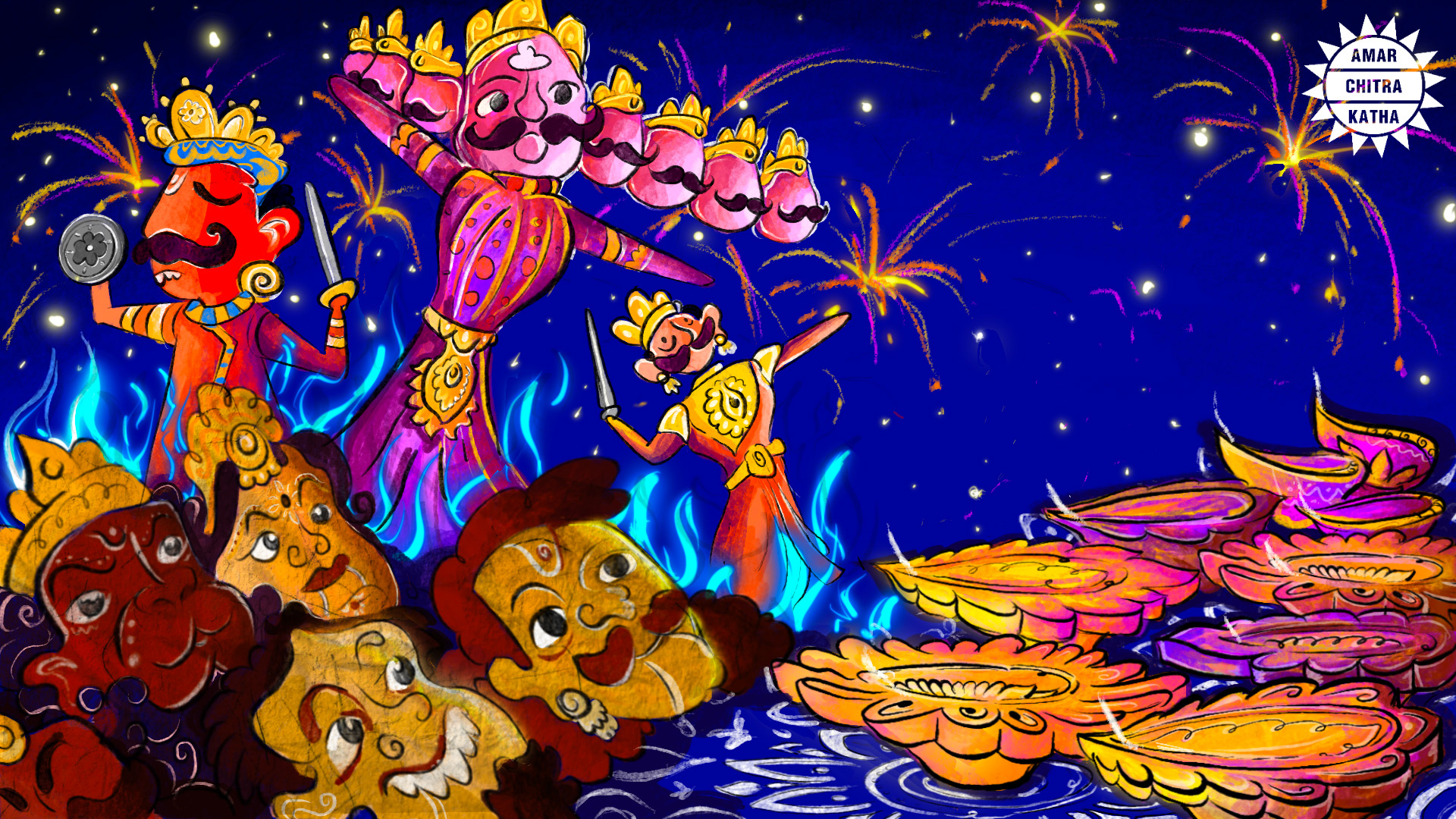
The festive season is filled with beauty. Flowers, rangolis, and diyas transform neighbourhoods for Dussehra and Diwali. These crafts are so woven into our celebrations that they often seem invisible. But who makes these objects, and what goes into making them? 

Building Ravana: The Effigy Makers of Dussehra 

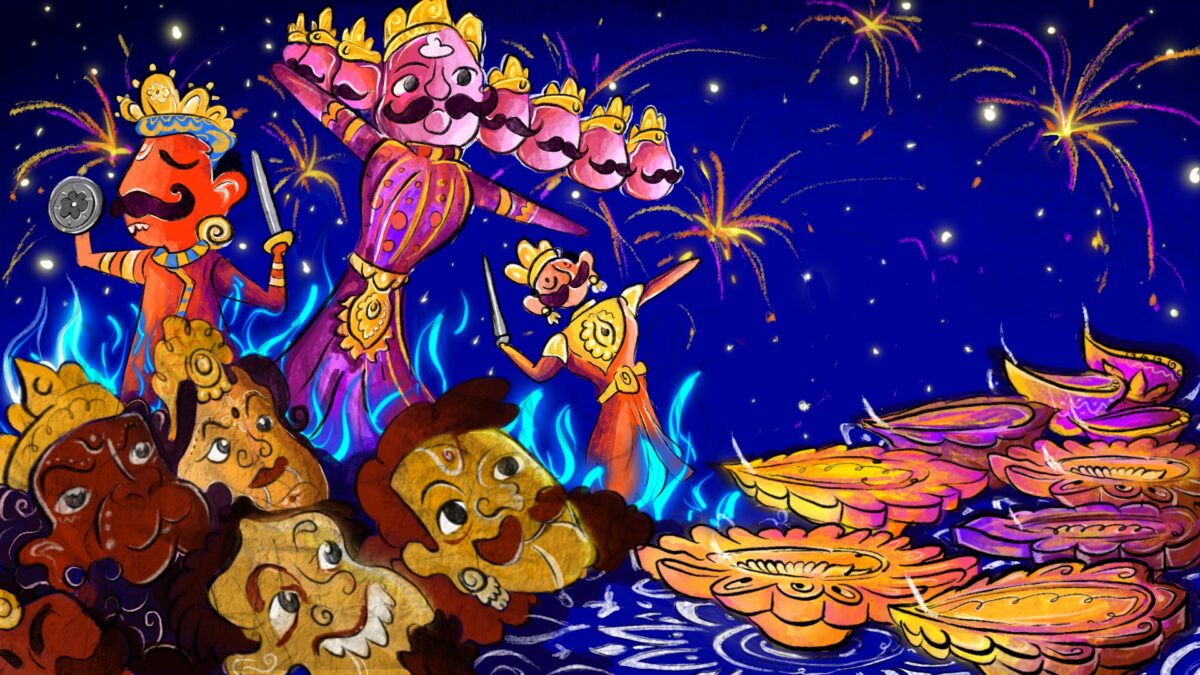
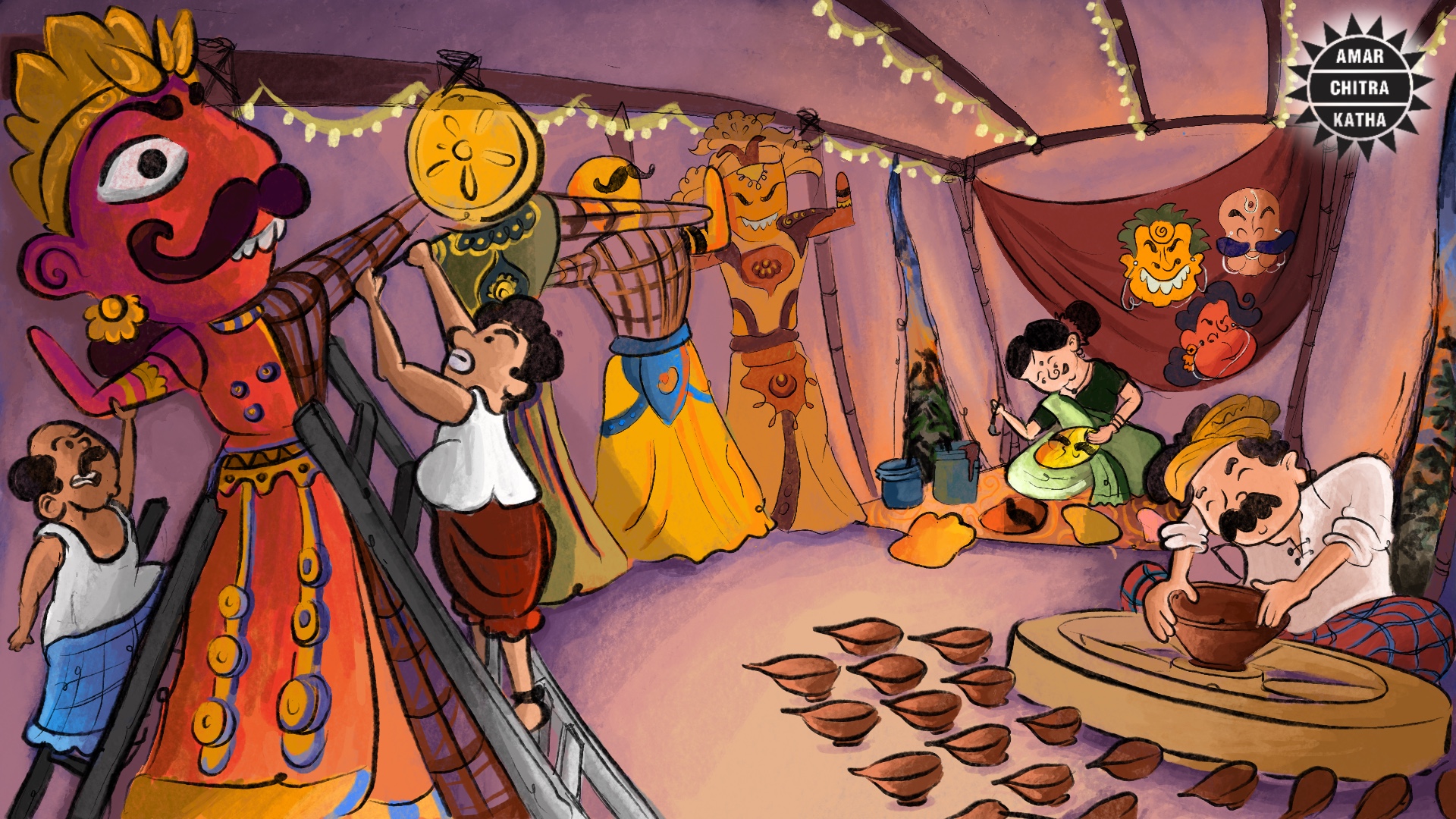
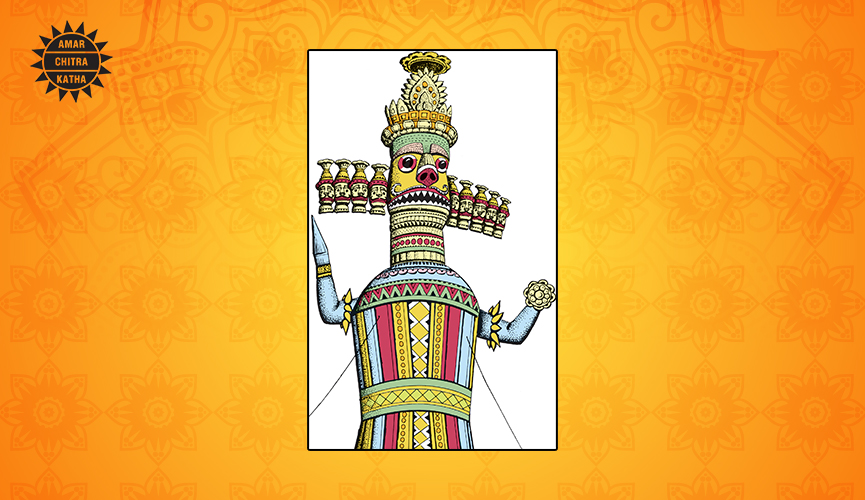
As early as August, the work for Dussehra’s biggest spectacle, the burning of grand Ravana effigies, begins. In Delhi’s Titarpur and across northern India, this is a months-long family affair of turning bamboo and cane into massive figures, some reaching up to 40 feet! 

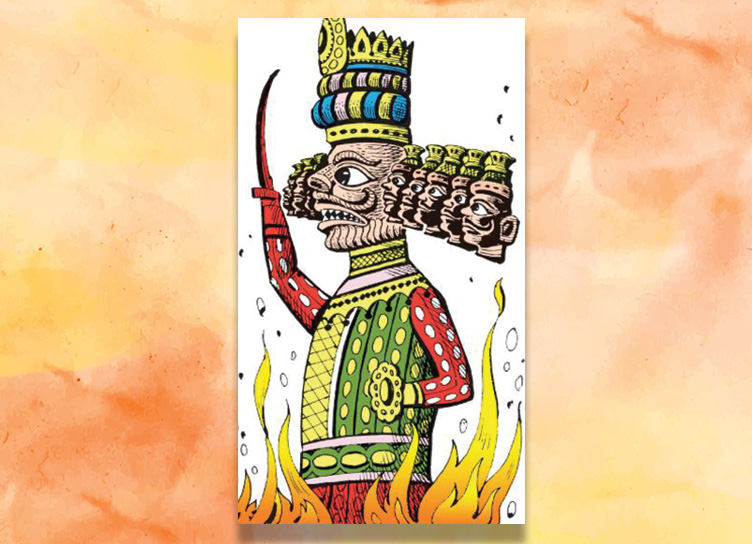
Effigy makers start by sourcing bundles of bamboo from local wholesalers. These are then split, bent, and woven into massive skeleton frames, a lightweight yet sturdy base that supports cloth and papier-mâché. Each body part is made separately: the torso, arms, legs, and, most importantly, the ten heads. All the features are exaggerated. Ravana is depicted with bulging red eyes and flared moustaches, made from papier mache, where glue and paper are alternatingly layered. 

After days of drying, the frames are painted in vivid traditional colours, decorated with sequins and vibrant fabrics, and dressed grandly. Firecracker garlands are carefully put in after all the decorating has been done, for the final dramatic burning. The work is collaborative; with the women and children also helping with colouring and assembly.  

Art: Saumya Ray
Masks of Ramlila: The Artists of Majuli Island 

On Majuli Island in Assam, the complex and vibrant masks of Ramlila are more than a source of livelihood; mask-making is a historic tradition passed down through centuries. This tradition is nurtured by the Satra community. Master craftsmen like Hemchandra Goswami and Haren Goswami are passing down the knowledge to apprentices, keeping it alive in the new generation.  

Masks of characters such as Rama, Hanuman and Ravana are made using split bamboo, cane, clay, cow dung, cotton cloth, and pith; a soft cork-like material. Craftsmen make bamboo frames which are then layered with cotton cloth dipped in a mixture of clay or cow dung. Each layer is painstakingly sundried. Each layer adds more details, and the mask grows more elaborate. Craftsmen add features like blinking eyes, moving mouths and eyebrows to make the features more expressive.  

The craft is kept alive both as a means of livelihood and a marker of cultural identity. Mask making is seasonal, ramping up during festival months but often supported by teaching workshops and tourism the rest of the year. As outside interest grows in the craft, artists have even adapted it across secular lines to make masks for a wide range of art and performances. 

Diyas: Lighting Festivals 

The diya might be smaller and simpler than the intricate effigies and masks, it is inseparable from the festival: every home glows with its presence.  

In the months leading up to Diwali, Kumhar and Kumbhar potter families shape thousands of diyas. Each diya begins with clay, sourced from riverbanks or the Western Ghats. The clay is then sifted for impurities, kneaded with water and shaped into diyas on a wheel by hand. Once the diyas are shaped, they are sundried and baked in makeshift kilns fuelled by scraps of wood and carboard. They are often painted and decorated by women and children before being taken to the market.  

For many families, Diwali is the busiest and most profitable part of the year, but the work is physically demanding, with cramped workshops and health risks. The kiln fumes while firing the diyas also pose an environmental challenge. Despite this, potters persist, driven by tradition, skill, and necessity.  

Art: Saumya Ray

The artisans behind these crafts – effigy makers, mask artists, and potters – are not just preserving tradition, they are also adapting to new challenges. Their skills carry centuries of culture and have shaped how communities celebrate these festivals. Artisan livelihoods, like the festivals themselves, are seasonal: intense and rewarding, but brief. For a few weeks, demand increases and communities come together, working with tradition. Supporting these local artisans as we carry out our own festivities does not just ensure that the season remains beautiful, but that the ancient traditions remain alive a bit longer.  

To read stories about Diwali and Dussehra, download our very own ACK Comics App

A Dussehra Beyond Borders: Dashain in Nepal 

By Keya Gupta

Marking the end of monsoon, communities across South Asia celebrate with festivals that commemorate the triumph of good over evil. In the month of Ashwin, the seventh month in the Hindu calendar, which is typically during September-October, India celebrates Dussehra with grand Ram-Leela performances and Ravana effigies. Similar celebrations occur across the region in Sri Lanka, Bangladesh, Thailand and Cambodia.

Art: Ram Waeerkar 

It is in Nepal, however, that Dussehra takes the expansive form of ‘Dashain’, celebrated across 15 days and touching nearly every household, whether Hindu or Buddhist. It celebrates Goddess Durga‘s victory over the demon, Mahishasura, symbolising the victory of righteousness and divine power. Unlike many Indian Dussehra or Durga Puja celebrations which are often shorter, Dashain’s celebrations create an atmosphere of festivity for weeks. Dashain shows us how the myths and festivals we are familiar with, have been adapted in Nepal. 

The first day of the festival is Ghatasthapana, when barley seeds are sown and nurtured in homes. This grows into a sacred grass called jamara. The barley seeds are grown over the days of the festival and by the end, they take on their distinctive yellow-green colour. This sacred grass is a symbol of prosperity and protection, like welcoming Goddess Durga into homes during Durga Puja.  

Throughout Dashain, families meet relatives, close and distant, to share the festive spirit, while donning new clothes and sharing meals to welcome the prosperity and blessings that Goddess Durga brings. Children streak the sky with kites, as is tradition, and kids and adults alike enjoy swinging on large traditional bamboo swings called ping. Both these traditions are more than just play. The kites are believed to be a way to send messages to the gods up in the skies, as the clouds clear out with the end of monsoon. Swinging in the ping is believed to be a way to rinse away the burdens and sins in one’s life.  

Maha Ashtami is the eighth day of the festival, when Durga is worshipped in her most frightening and fierce form of Kali, and is appeased through the sacrifice of animals and poultry. On Maha Navami, the ninth day, people worship their tools, vehicles, and instruments; a practice similar to the Vishwakarma Puja in India. This ritual recognises the importance of tools and implements in livelihoods and the conveniences in daily life that are often taken for granted, seeking divine protection for the safety of the things that provide livelihood.  

Art: Ram Waeerkar 

The main day of Dashain is Vijaya Dashami, the tenth day of the festival, when Durga slayed Mahishasura. Elders apply a ‘tika’ which is a mixture of red vermillion, curd, rice and the sacred jamara on the foreheads of younger family members. The jamara in the tika ties one to the earth and nature’s bounties, reflecting the end of the harvest season. Historically, this tradition of tika harks back to the largely agrarian and warrior culture of Nepal. After a period of agricultural rest during the first nine nights or Navratri of the Dashain period, it symbolises farmers or warriors receiving it as a symbol of protection and strength before returning to work.  

The festival’s last and final day falls on a full moon, called the Kojagrat Purnima or Sharad Purnima. Kojagrat literally means ‘one who is awake’, and it is believed that Lakshmi, the goddess of prosperity, descends to Earth on this night and showers the ones who stay awake all night, with blessings.  

As Dussehra and Dashain light up homes, they remind us that despite regional differences, the essence and spirit of these festivals is the same — the triumph of good over evil and the joy of togetherness and community.   

Read stories from Hindu Mythology at our very own ACK Comics App

The Astrology of Navratri

By Keya Gupta

In Indian culture, astrology is more than a tool to predict our ever-changing lives. It is the thread that connects everyday life to the stars and sky. As Sharad Navratri arrives, the air grows crisp and the seasons turn, along with a shift in the spiritual landscape. This is the festival that honours Goddess Durga, whose power is mirrored in the skies and the cycles of nature. 

Navratri means ‘nine nights’, a time where Goddess Durga is worshipped in her nine different forms. Each night is a step in the journey from darkness and struggle to clarity and transformation. The festival represents the triumph of good over evil, light over darkness, and knowledge over ignorance as Durga slays the demon, Mahishasura. But Navratri is also deeply tied to astronomy and astrology, with each day’s timing and meaning influenced by the planets and their movements.   

Sharad Navratri begins around the autumn equinox, the time when day and night are almost equal in length; highlighting balance in the universe, a natural balance in the earth’s cycle, and the shift from summer into the cooler season. The equinox reminds us of balance not only in the outside world but also in our inner lives. Just like day and night are equal and in harmony during this time, Sharad Navratri encourages us to find balance within ourselves.  

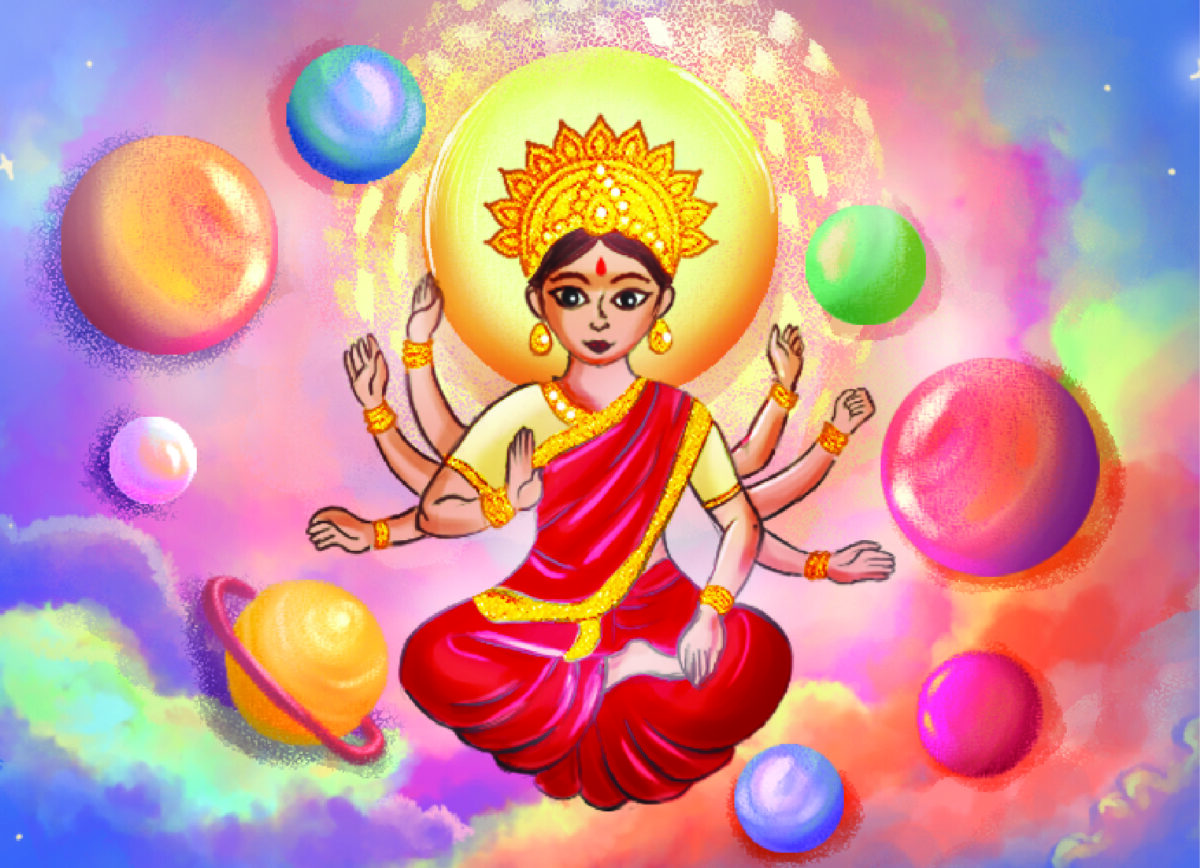
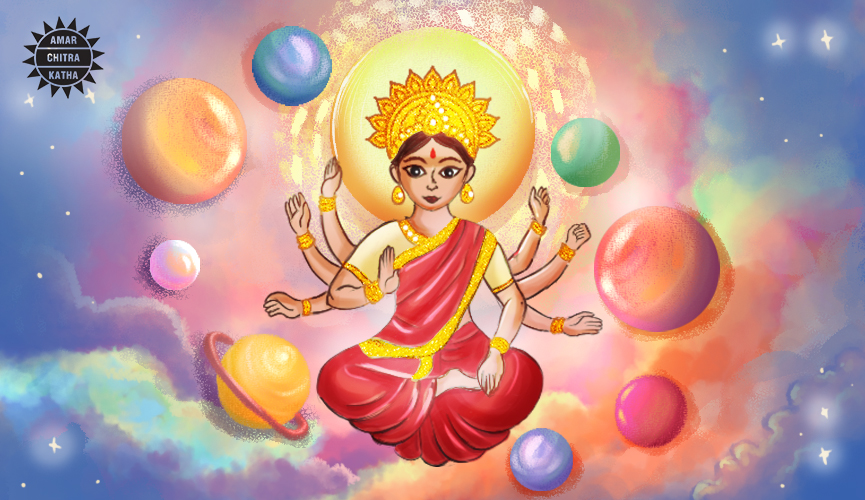
Each night of Navratri celebrates one of the nine forms of Goddess Durga, each representing different qualities like strength, courage, wisdom, and protection. Each of the nine days and corresponding forms of Durga is linked to the ‘Navagraha’ of Hindu astrology: Moon, Mars, Mercury, Jupiter, Venus, Saturn, Sun, Rahu, and Ketu. By praying to each form, we seek harmony with the energies of these cosmic bodies. The movements of these bodies influence the timing of the festival, making it a special time when spiritual and universal energies are aligned.  


Illustration: Harshal N. and Srinath Malolan

Why nine nights? The number nine holds a significant position in both mathematics and spirituality. Nine is the last digit before numbers repeat in cycles, as the digits ‘1’ and ‘0’ begin to repeat after ‘9’, symbolising completion and renewal. In Hindu thought, nine signals the end of one cycle and the beginning of another, representing rebirth, transformation, and infinity. Nine is the apex, both an ending and ushering of a new start. During Navratri, nine marks the harmony of the physical and spiritual, the journey through stages of life, from ignorance to finding the divine. The nine forms of Durga depict the nine stages of individual growth from death to rebirth, cleansing, and enlightenment. Even the structure of the Vedas and the planetary system is shaped by nines, reflecting a universe that moves in cycles, guided by the Navagraha. With each turn of the seasons and each phase of the moon, the number nine reminds us to recognise the rhythms of nature in our own lives.  

Sharad Navratri is more than a festival; it is a celebration of the skies and spiritual growth. As people light lamps and offer prayers, they participate in a tradition that honours the relationship between the stars and human life. For nine sacred nights, under the changing skies, Navratri invites us to embrace change, seek balance, and move toward renewal. 

To read more stories about Durga and other goddesses, head over to our very own ACK Comics App.