



Kabir: The Poet Who Belonged to Everyone
- June 29, 2026


Kabir: The Poet Who Belonged to Everyone
- June 29, 2026
Keya Gupta
Kabir was a 15th-century mystic poet and saint whose two-line verses, called dohas, have been remembered and recited across India for over five hundred years. He was highly revered by Hindus, Muslims, and Sikhs alike, cherished in the traditions of all three religions. His birth anniversary, or Kabir Jayanti, is celebrated on the full moon day of the Hindu month of Jyeshtha. It falls on 29th June this year. Every year his devotees mark the occasion with bhajan gatherings, kirtans, poetry readings, and spiritual discourses, especially in states like Uttar Pradesh, Maharashtra, Madhya Pradesh, and Gujarat. The most elaborate celebrations take place in Varanasi, his birthplace, where religious sermons are held at Kabirchaura Mutt.

The details of Kabir’s birth remain uncertain, and researchers can only provide a broad time period for it, roughly between 1440 and 1518 CE. He was born in Varanasi, and according to one of the most popular legends surrounding his birth, he was raised by a couple of Muslim weavers named Niru and Nima, who found him as an infant near a pond called Lahar Tara and adopted him.
To receive more such stories in your Inbox & WhatsApp, Please share your Email and Mobile number.
Kabir was a poet of the masses, composing in the accessible, everyday languages of the region such as Awadhi, Braj, and Bhojpuri. Varanasi was a centre of religious life in the subcontinent, home to Hindu sadhus, Islamic sufis, Buddhists, Jains and others, each of whom had set up their own mosques, monasteries, and temples in the city. Growing up amidst all of this, Kabir came to be associated with both the Vaishnava tradition of Hinduism and the Sufi tradition of Islam. Soon, he found out about Ramananda, a prominent saint of the Bhakti movement, known for welcoming disciples across caste lines. It was through him that Kabir found his spiritual footing. Ramananda taught that God was inside every person and everything — a belief that Kabir would carry through his entire life and work.

Although Kabir is often depicted as a harmoniser of Hindu and Muslim belief, it would be accurate to say he was equally critical of both. He had little patience for priests who recited scripture without understanding it, for pilgrims bathing in the Ganga without changing how they lived, or for those performing religious rituals as a matter of habit rather than genuine feeling. He dismissed pilgrimages, idol worship, and the authority of scriptures like the Vedas and the Quran when these became substitutes for genuine inner devotion, arguing that the path to God lay through direct personal experience, not through intermediaries or ceremony. He also pushed back openly against caste, insisting that birth into a particular community said nothing about a person’s worth or spiritual standing.
One of his most quoted dohas captures this:
जाति न पूछो साधु की, पूछ लीजिए ज्ञान।
मोल करो तरवार का, पड़ा रहन दो म्यान।।
Do not ask the caste of a saint; seek their wisdom.
Value the sword, let the sheath lie where it is.
In his final days, Kabir made one last point. People at the time believed that dying in Kashi guaranteed heaven, while dying in Maghar, a small town in Uttar Pradesh, meant condemnation. To challenge this superstition, Kabir chose to go to Maghar, and died there in 1518. After his death, his Hindu and Muslim followers disputed what to do with his body. The Hindus wished to cremate him, while Muslims wished to bury him. Legend has it that when they lifted the cloth covering him, they found only flowers in his place. The two communities divided the flowers and carried out the last rites according to their own customs. Today, his samadhi (memorial, associated with Hinduism/Buddhism) and mazaar (tomb, associated with Islam) stand side by side.

Even in his final moments, Kabir resisted the idea that people could only belong to one religion. On Kabir Jayanti, his dohas remind us that the questions he raised; about faith, identity, and how we treat one another, are ones that remain timeless.
Read more stories on Indian Mythology, History and Culture on our very own ACK Comics App.
To receive more such stories in your Inbox & WhatsApp, Please share your Email and Mobile number.
Comic of The Month
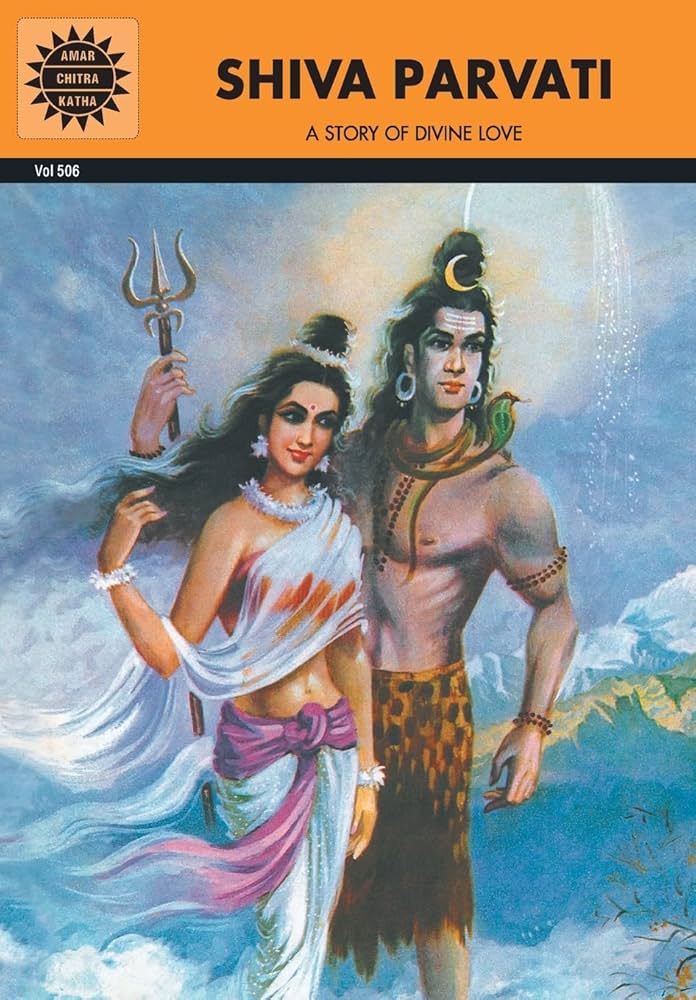
Shiva Parvati
A powerful demon threatens the gods in their heaven. They need a savior, who, Lord Brahma decrees, will be the son born to Shiva and Parvati. But Shiva, a badly-dressed, untidy, solitary ascetic, seems to enjoy bachelorhood. Even Parvati's unmatched beauty aided by Kama, the god of love, seems unequal to the task of enchanting the stern lord. This illustrated classic is based on Kumara Sambhava of Kalidasa.

