


Grassroots Warriors: The Story behind the Chipko Movement
- April 22, 2026

Grassroots Warriors: The Story behind the Chipko Movement
- April 22, 2026
by Nidhi Murthi
‘Ecology is a permanent economy.’ – Sunderlal Bahuguna
In the Himalayan forests of Uttarakhand, a group of women once stood between axes and the trees that had sustained them most of their lives. This gave birth to the ‘Chipko Movement’ — one of India’s most important environmental movements. On this World Earth Day, let us learn how this story feels more relevant now than ever.
To receive more such stories in your Inbox & WhatsApp, Please share your Email and Mobile number.
The villagers who lived in the Himalayan region of Uttarakhand (then part of Uttar Pradesh) depended heavily on the nearby forests for their daily needs, such as fuelwood for cooking, timber for houses, and protection from soil erosion. During British colonial rule, laws were introduced under the Indian Forest Acts, which gave the government rights over natural resources in certain regions while limiting those of the local communities. After the Sino-Indian War in 1963, increased road construction and development led to further deforestation, which distressed the villagers.
The tipping point came when the Uttar Pradesh Forest Department granted logging contracts to Symonds Company from Allahabad to cut trees. This angered villagers in the Chamoli district who felt that their needs were being ignored. With support from environmentalists such as Chandi Prasad Bhatt and his organisation, the Dasholi Gram Swarajya Sangh (DGSS), later known as the Dasholi Gram Swarajya Mandal (DGSM), the villagers began to protest to protect their trees.
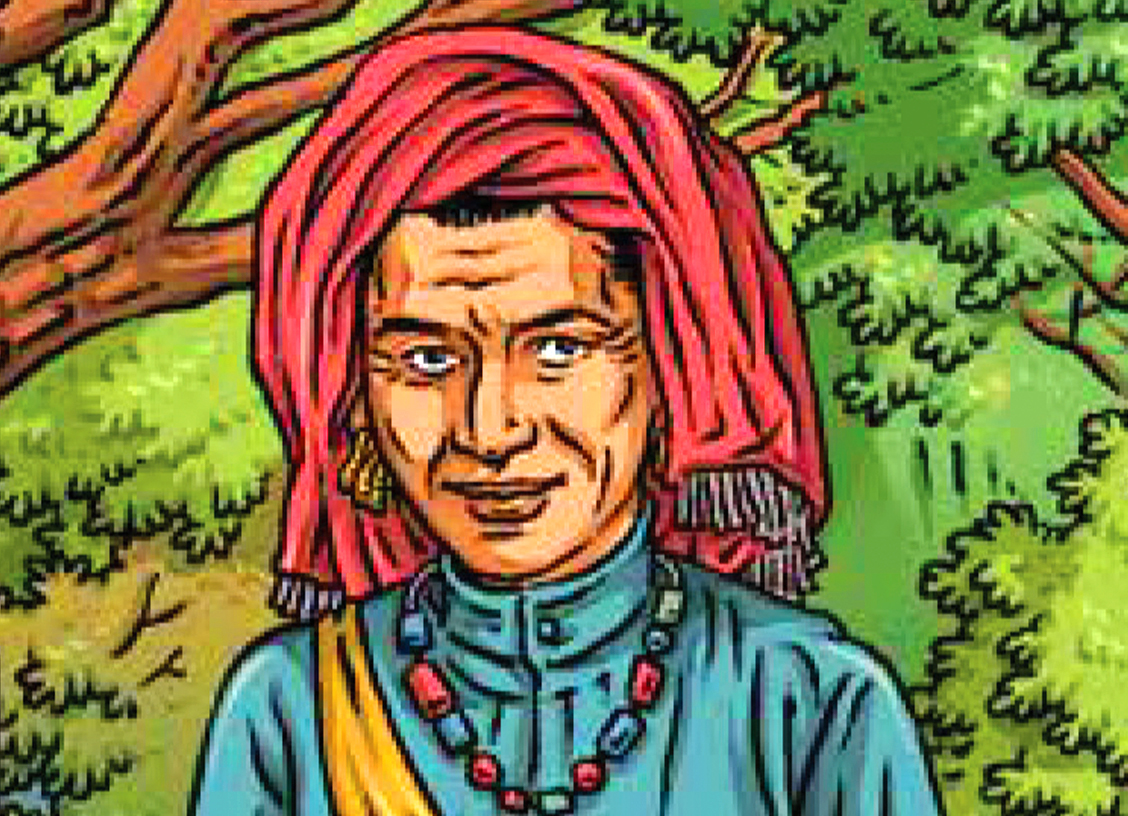
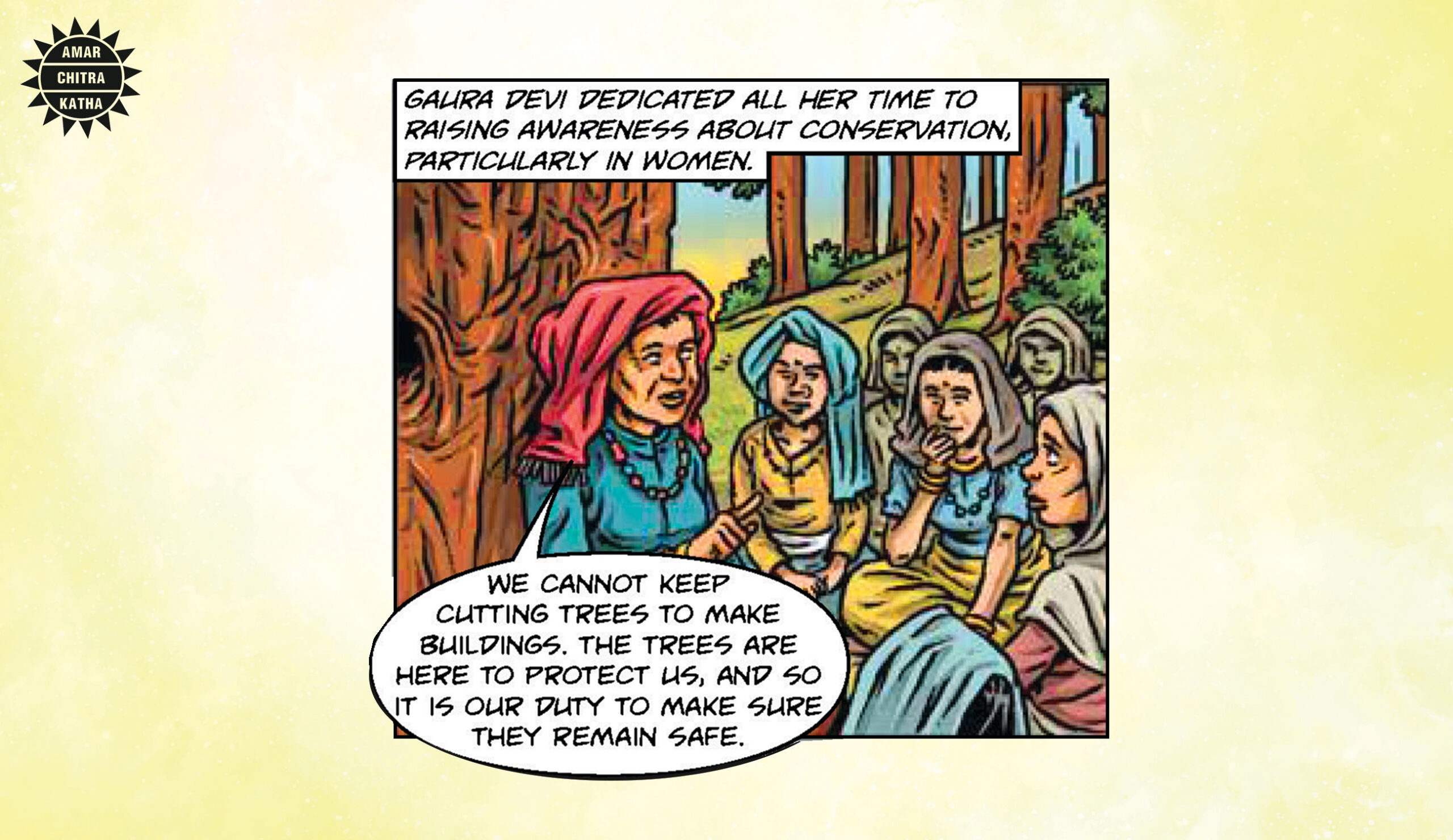
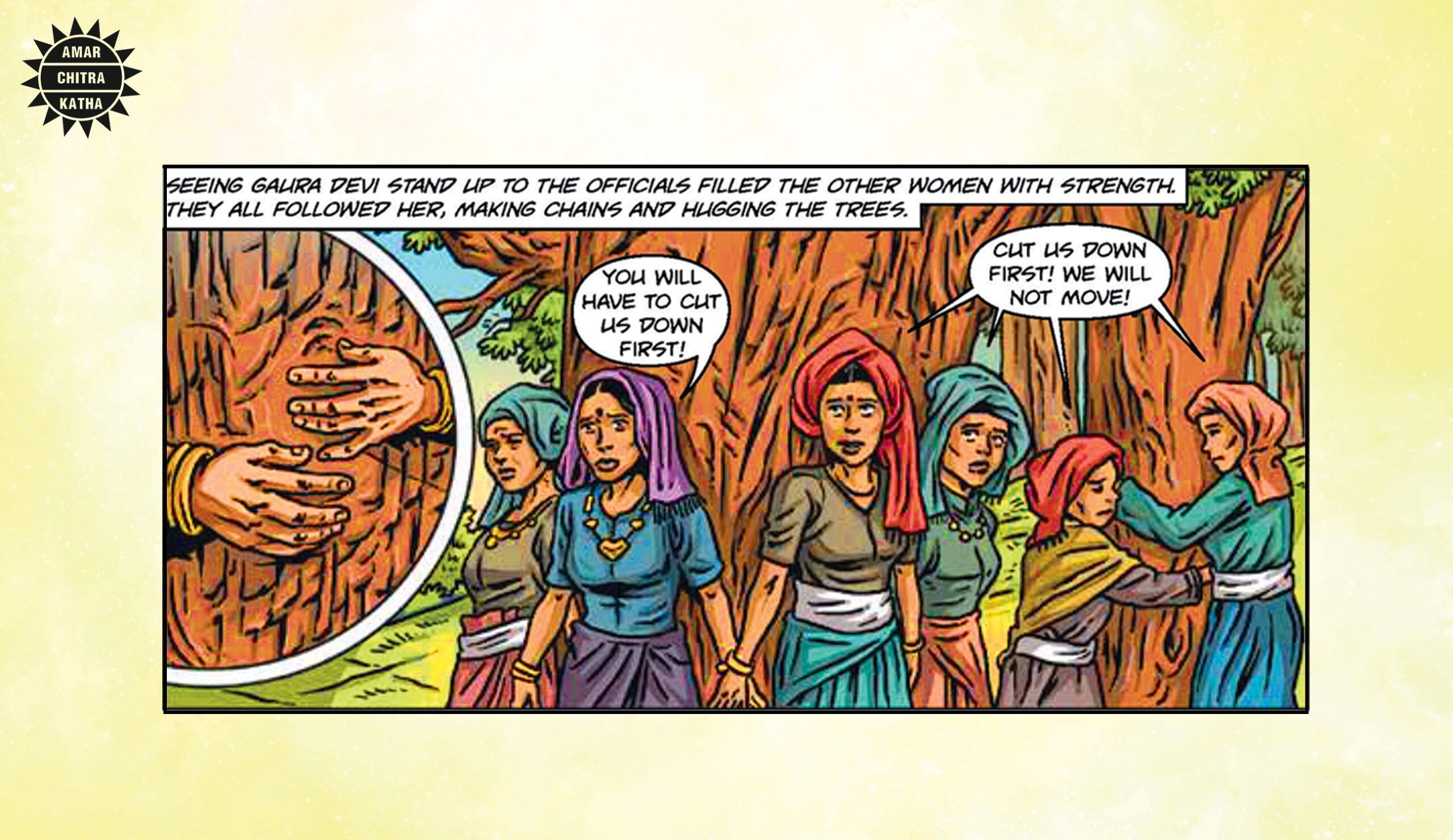
A defining moment came in March 1974, in Reni village (present-day Raini). When loggers were appointed to Reni, the men of the village were deliberately lured away under the pretext of receiving compensation. The women knew that saving the trees meant saving their children’s future. When the loggers arrived, they underestimated the determination of these women. As they advanced, the women, led by Gaura Devi, hugged the trees and refused to move till they left. The loggers realised that harming the trees meant striking the women first. Faced with such fierce and non-violent resolve, the loggers retreated.
The protest was so impactful that the government ordered a 10-year ban on cutting trees in the region.
The word ‘Chipko’ means ‘to embrace’ in Hindi. Since the women had ’embraced’ the trees, as news of the protest spread across the nation, it came to be known as ‘The Chipko Movement’.
Environmentalists like Sunderlal Bahuguna spread the message of the movement across the nation after this incident in 1974. During that time, people in the Himalayan villages had limited access to newspapers and other types of media. So, the villagers used folk songs and marches to spread the message to other parts of the hills and India. They began organising similar protests to protect their forests. Between 1972–1979, more than 150 villages were involved, resulting in 12 major protests and many minor confrontations in Uttarakhand. In 1978, the local women in the Tehri Garhwal district, Uttarakhand, tied sacred threads around the trees and recited verses from the Bhagavad Gita to stop the loggers. In Pulna village in the Bhyundar valley in the same year, the women confiscated the loggers’ tools and left receipts for them to be claimed if they withdrew from the forests. In some areas, chir pine trees that had been tapped for resin were also bandaged to prevent further exploitation of trees. The Chipko movement also inspired other environmental movements in India, including the 1983 Appiko Movement (‘Appiko’ means ‘to hug’ or ‘to embrace’ in Kannada), in Karnataka. As the support grew, the pressure also increased on the government to adopt policies that addressed people’s needs and were beneficial for the environment.
While the movement was carried out by thousands of villagers, several leaders joined them and strengthened their hands. Among them, besides Gaura Devi and Sunderlal Bahuguna, were Chandi Prasad Bhatt and Dhoom Singh Negi. Sunderlal Bahuguna started the ‘Save the Himalayas’ movement and went on a historic 5,000 kilometre Trans-Himalayan foot march that took almost two years to complete. In this time, he highlighted the importance of protecting nature for future generations and connected with the villagers through folk songs. Social activist Dhoom Singh Negi fasted for five days to protest the commercial logging of the forests, which inspired people to participate in the movement.
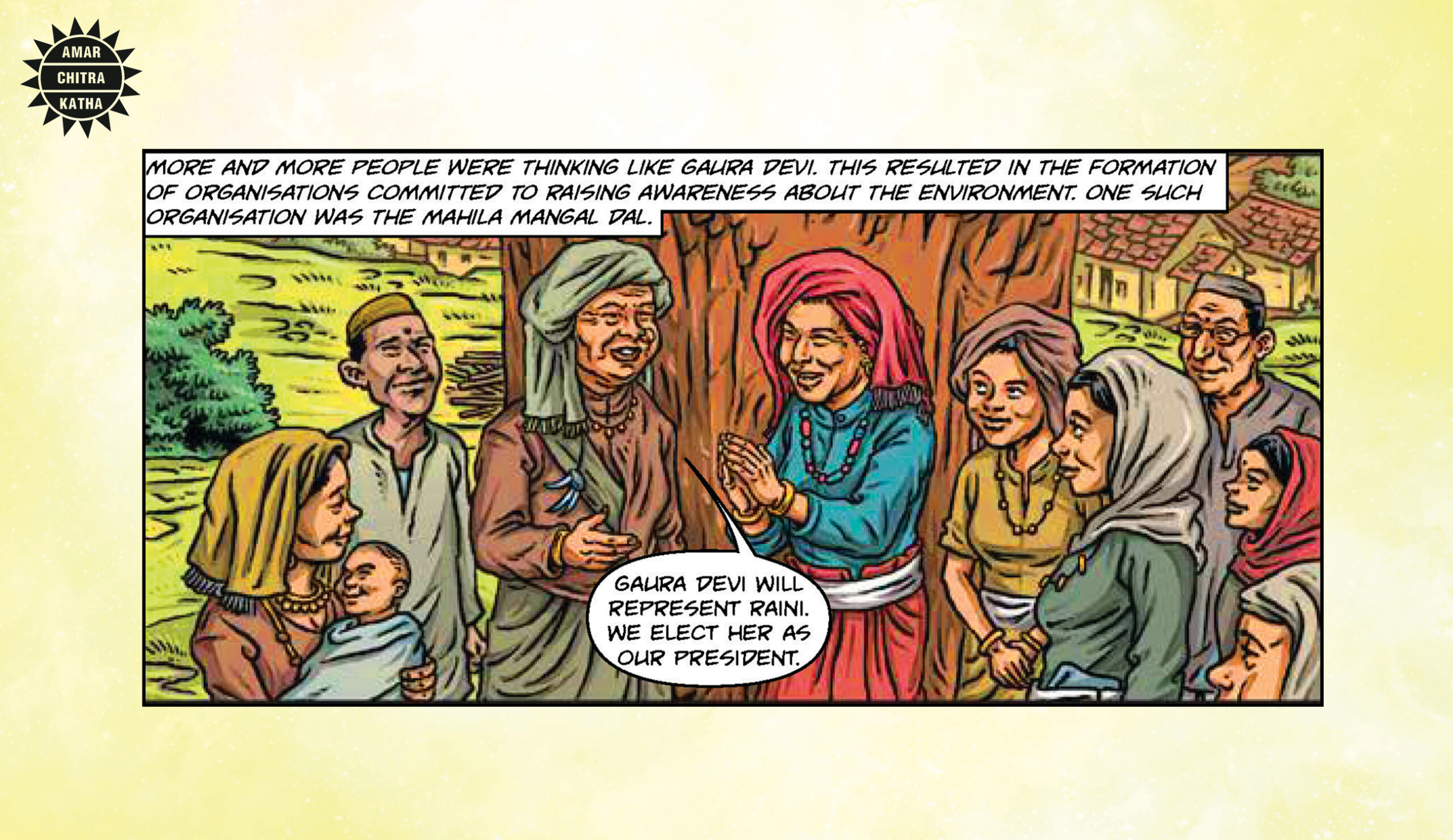
In 1980, the movement reached a turning point when Prime Minister Indira Gandhi announced a 15-year ban on commercial tree felling in the Himalayan forests. It was a landmark victory that proved a movement led by ordinary people, especially women, could bring positive changes to national policy through peaceful, collective action.
The Reni village protest showed women leading and carrying the movement across the nation. The image of women hugging trees in the hills of Uttarakhand remains one of the most powerful symbols of environmental care in India. Decades later, as the world faces environmental challenges, the voices of those Himalayan villages still guide us, reminding us that even the smallest acts of courage can protect the planet.
Read stories on Indian History, Mythology and Culture at our very own ACK Comics App.
To receive more such stories in your Inbox & WhatsApp, Please share your Email and Mobile number.
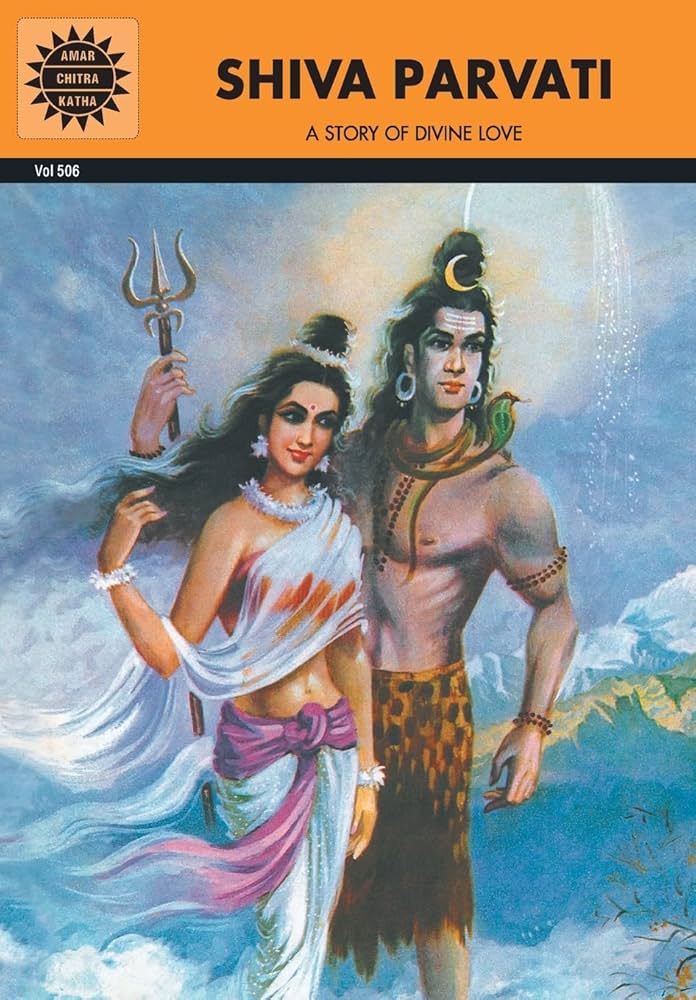
Comic of The Month
Shiva Parvati
A powerful demon threatens the gods in their heaven. They need a savior, who, Lord Brahma decrees, will be the son born to Shiva and Parvati. But Shiva, a badly-dressed, untidy, solitary ascetic, seems to enjoy bachelorhood. Even Parvati's unmatched beauty aided by Kama, the god of love, seems unequal to the task of enchanting the stern lord. This illustrated classic is based on Kumara Sambhava of Kalidasa.